A free fishing guide for South African anglers
Never fished before, trying a new style, or after a new species? BaitLine's Fishing guide covers what each style costs to start and how to set up, how to catch 60 South African fish, the knots, and the basics - written for SA waters, in English and Afrikaans.
New to fishing? Your first trip
Papgooi is the easiest way to start: cheap, relaxed, and it works on almost any dam. The guide walks you through a whole first day, start to finish - what to pack, how to set up, and what to do when a fish takes.
Seven fishing styles
Each style covers what's different if you already fish, what it costs to start, the must-have and nice-to-have kit, a step-by-step setup, tips, common mistakes, the knots to learn, and how to take it further.
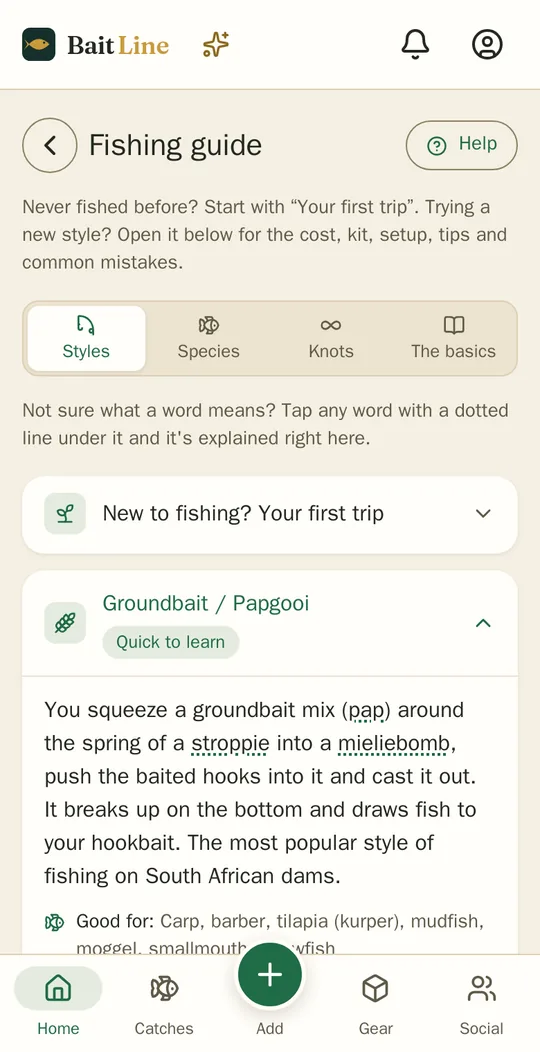
Groundbait / Papgooi
You squeeze a groundbait mix (pap) around the spring of a stroppie into a mieliebomb, push the baited hooks into it and cast it out. It breaks up on the bottom and draws fish to your hookbait. The most popular style of fishing on South African dams.
Good for: Carp, barber (barbel), tilapia (kurper), mudfish, moggel, smallmouth yellowfish
Specimen carp
Patient fishing for the biggest fish in the water, often for a whole day or night. The bait hangs just below the hook on a thin line (the "hair"), a heavy lead pulls the hook in when the carp swims off, and a bite alarm beeps to tell you.
Good for: Big carp, grass carp
Bass & lure fishing
You cast a fake bait (a lure) and wind it back, so a hungry fish chases it and bites. You keep moving and try lots of spots.
Good for: Largemouth and smallmouth bass, yellowfish, tigerfish
Light shore fishing
Light rods with small lures or baits, off the rocks, harbour walls and jetties, and in estuaries. You fish the water close in, where lots of sea fish feed, and feel every bite.
Good for: Shad, garrick, grunter, kob, blacktail, karanteen, pinky
Fly fishing
The weight is in the line, not the lure: you cast a heavy fly line that carries an almost weightless fly made to look like an insect or a small fish.
Good for: Trout, smallmouth yellowfish, bass
Surf & rock fishing
Casting a bait into the surf from the beach or off the rocks. Heavier tackle to cast a sinker out to where the fish feed and hold it there in the waves.
Good for: Kob, galjoen, shad, blacktail, steenbras, grunter
Boat fishing
Fishing from a boat, kayak or ski-boat gets you to water you can't reach from the bank: deep reefs, islands and fish far out at sea.
Good for: Bass and tigerfish on dams; yellowtail, snoek, tuna and reef fish at sea
60 fish species, freshwater and saltwater
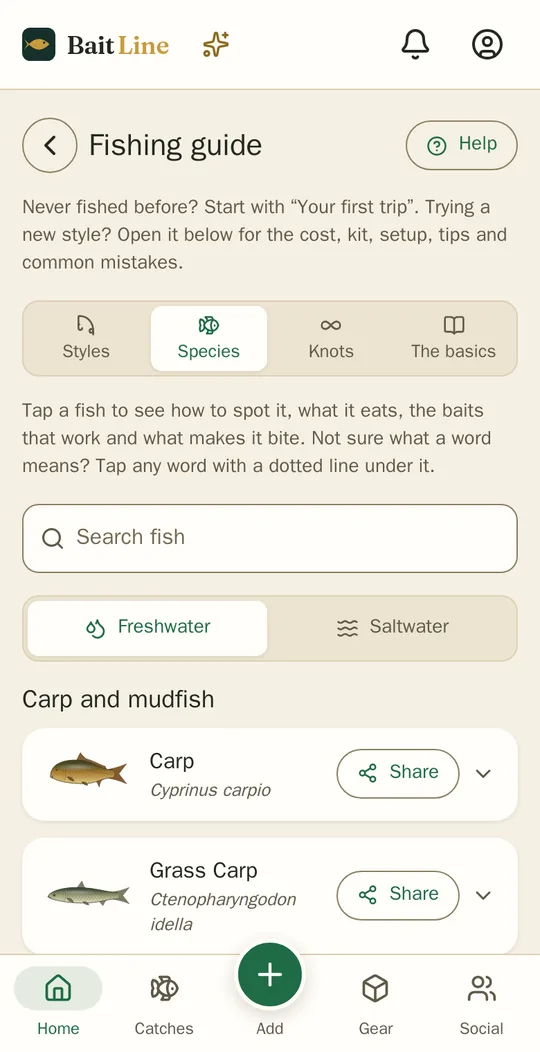
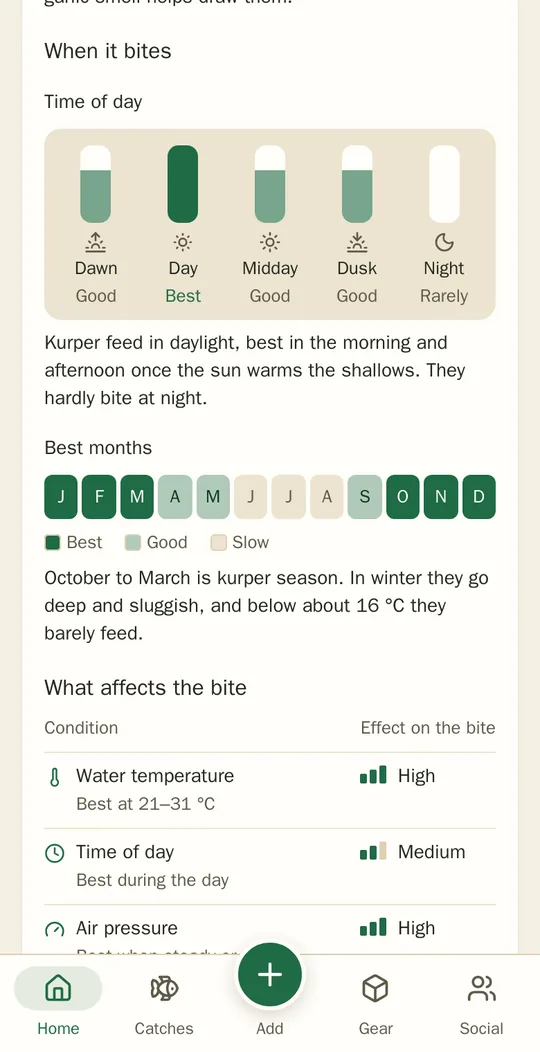
Pick a fish and the guide tells you how to spot it (with its varieties and the fish it's often mistaken for), what it eats and where it feeds, how to catch it and which methods work best, the baits, lures and flavours it takes, when it bites through the day and the year, and what affects the bite - water temperature, pressure, cloud, wind, rain, water clarity, the moon and spawning, plus tide and swell for sea fish. Search by English, Afrikaans or scientific name.
Freshwater
- Carp and mudfish - Carp, Grass Carp, Mudfish, Moggel, Rednose Labeo
- Yellowfish - Largemouth Yellowfish, Smallmouth Yellowfish, Clanwilliam Yellowfish, Papermouth
- Trout and bass - Trout, Largemouth Bass, Smallmouth Bass, Spotted Bass
- Kurper and tilapia - Kurper, Blue Tilapia, Nile Tilapia, Redbreast Tilapia, Banded Tilapia, Threespot Tilapia, Greenhead Tilapia, Nembwe
- Barber and eels - Barber, Vundu Catfish, Eel, Longfin Eel
- Big river predators - Tigerfish, African Pike, Nile Perch
- More Zambezi fish - Chessa, Nkupe, Cornish Jack, Bulldog
Saltwater
- Surf and estuary - Kob, Geelbek, Spotted Grunter, Shad, Garrick
- Rocks and gullies - Galjoen, Blacktail, Karanteen, Cape Stumpnose, Steenbras, Musselcracker, Black Musselcracker
- Reef fish - Red Roman, Red Stumpnose, Santer, Slinger, Potato Bass
- Gamefish - Giant Trevally, Queenfish, King Mackerel, Barracuda, Snoek, Yellowtail
- Deep sea - Tuna, Wahoo, Dorado, Sailfish, Black Marlin
To see how today's conditions add up for a species, check its fishing forecast, scored hour by hour.
Fishing knots, step by step
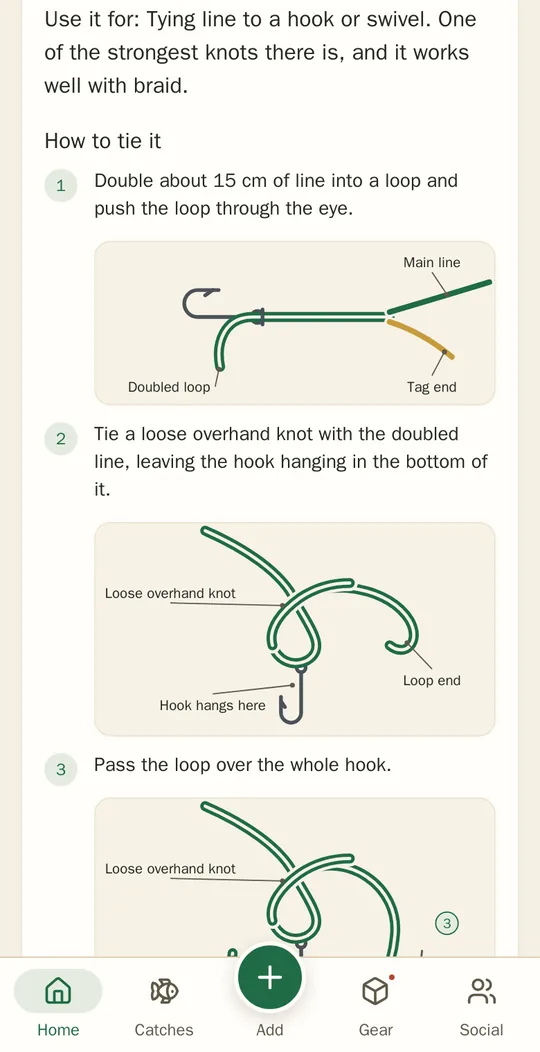
Every knot has numbered steps with clear drawings, a tip, and a link to watch it being tied.
- Uni knot - Tying line to a hook, swivel or lure, or onto an empty reel spool. If you only learn one knot, learn this one.
- Improved clinch knot - Tying nylon or fluorocarbon to a hook, swivel, lure or fly. Quick and reliable, but not for braid.
- Palomar knot - Tying line to a hook or swivel. One of the strongest knots there is, and it works well with braid.
- Double uni knot - Joining two lines: braid to a fluorocarbon leader, main line to a shock leader, or tippet to a fly leader.
- Knotless knot (hair rig) - Carp hair rigs. The bait hangs off the hook on a "hair", so the hook point is free to catch hold when a carp sucks the bait in.
- Surgeon's loop - A strong, quick loop at the end of a line: for making your own stroppies and traces, and for joining two loops together.
The basics
Short, plain-language explainers on everything else, from your first rod to staying safe on the bank: packing essentials, setting up a rod, spooling a reel, rods, reels, line, hooks, sinkers, swivels, clips and stops, stroppies, bite indicators, floats, getting unsnagged, baits, baiting a hook, lures, landing a fish, keeping a fish, where and when to fish, staying safe, handling and releasing fish, good manners on the bank, and the words anglers use.
Made to use on the bank
- Tap any word with a dotted line under it for a quick explanation - no fishing jargon left unexplained.
- Share any species, knot or basics topic as an image - to WhatsApp, or anywhere.
- Jump from "Where and when to fish" straight to today's fishing forecast.
Questions
Is the BaitLine fishing guide free?
Yes. The whole Fishing guide is free for every BaitLine account - open it from Home, under Tools.
What's the best fishing knot for beginners?
The uni knot. It ties line to a hook, swivel or lure, or onto an empty reel spool - if you only learn one knot, learn this one.
What is papgooi?
Papgooi is groundbait fishing: you squeeze a groundbait mix (pap) around a stroppie into a mieliebomb, push the baited hooks into it and cast it out. It is the most popular style of fishing on South African dams, and the easiest way to start.
Which fish species does the guide cover?
60 South African species, freshwater and saltwater - from carp, kurper, yellowfish, bass and tigerfish to kob, galjoen, steenbras, yellowtail and marlin. Each one covers how to spot it, what it eats, how to catch it, the baits and flavours that work, when it bites and what affects the bite.
How much does it cost to start fishing?
It depends on the style. Every style in the guide lists a rough cost to get started with decent entry-level gear from a tackle shop, plus the must-haves and the nice-to-haves you can add later.
Is the fishing guide available in Afrikaans?
Yes - the whole guide is in English and Afrikaans, and follows the language you choose in the app.
Open the guide
Sign up free and find the Fishing guide on Home, under Tools - then log your first catch.