
Snoek
Thyrsites atun
The Cape's classic winter boat fish: a long, toothy shoal fish caught on spinners, cut bait and handlines from ski-boats.
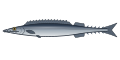
Size: Most snoek caught weigh 2–4 kg, and fish of 6 kg are not uncommon. The SA angling record is 8.4 kg, caught at Hout Bay in 1974.
Where: Cape waters from Namibia to about Cape Agulhas, and only rarely as far east as Algoa Bay. Anglers fish for them from the west coast (Lambert's Bay, St Helena Bay) down to Hout Bay, Cape Point and False Bay.
How to spot it
A long, thin, silver fish with a dark blue-grey back and a pointed head. The long, low first dorsal fin runs along most of the back, followed by a small second dorsal fin and a row of small finlets near the tail. The big mouth has long, sharp fangs at the front. On the KZN coast anglers often call the queen mackerel 'snoek', but that is a different fish with spots.
What it eats
Big snoek eat mostly sardine and anchovy, plus horse mackerel, hake, squid and small crustaceans. They stay deep by day and rise towards the surface at night, and a feeding shoal chases bait right up to the top.
Where it feeds
- Over banks and reefs off Cape Point, such as Rocky Bank and the Anvil
- Inside False Bay at Buffels Bay and off Millers Point
- Where the commercial handline boats are anchored
- Anywhere from near the bottom to the surface, wherever the bait is
How to catch it
Fish from a boat where the shoals show on the sounder, or where the commercial boats are. Let a cut bait (fish, sardine or chokka) sink slowly on a light, free-running sinker, or cast a heavy spinner and let it sink on a tight line. Use a thick fluorocarbon leader or a short wire trace, because snoek bite through ordinary line. Many snoek take the bait or lure while it sinks.
| Way of fishing | How well it works |
|---|---|
| Bait on the bottomA sinker holds your bait still on the bottom. | Sometimes |
| Under a bobberA bobber is a small buoy on your line: it holds the bait off the bottom and dips under when a fish bites. | Not used |
| Natural or dead baitReal food on the hook: worms, liver, sardine, chokka. | Best |
| Live baitA small live fish or other live creature on the hook. | Sometimes |
| LuresArtificial baits you cast and reel in: spinners, spoons, plastics. | Best |
| TrollingLures or bait pulled behind a moving boat. | Works well |
| Fly fishingLight artificial flies, cast with a fly rod. | Sometimes |
Baits and lures that work
- Fish strips or dead fish
- Chokka (squid)
- Sardine
- Metal jigs
- Spoons
- Crankbaits and plugs
Flavours it likes
- Fish
- Squid
Snoek go for oily fish and squid: fresh sardine, cut fish and chokka. Chopped bait thrown in as chum helps hold a shoal under the boat.
When it bites
Time of day
| Time | Bite |
|---|---|
| Dawn | Best |
| Day | Good |
| Midday | Slow |
| Dusk | Best |
| Night | Slow |
Early morning is usually best, and the bite can pick up again late in the afternoon. By day the shoals often sit deep, so fish lower down when the sun is high.
Best months
- Best: May, June, July, August, September
- Good: January, February, March, April, October, November, December
On the west coast snoek are a winter fish, with most caught from May to September. Around Cape Point and False Bay recent runs have come from September to January, and the shoals move around a lot from year to year.
What affects the bite
| Condition | What it likes | Effect on the bite |
|---|---|---|
| Water temperature | Best at 13–18 °C | Medium |
| Time of day | Best at dawn and dusk | Medium |
| Tide | Hardly matters | Low |
| Swell and surf | Best when the sea is calm | Medium |
| Air pressure | Best when it is falling | Medium |
| Cloud cover | Best on overcast days | Low |
| Wind | Best with a light breeze | High |
| Rain | Best in dry weather | Low |
| Water clarity | Hardly matters | Low |
| Moon phase | Hardly matters | Low |
| Spawning | Feeds hard before and after spawning | Medium |
High means it makes a big difference to whether this fish bites. Low means it hardly matters.
Tips
- Watch the commercial handline boats: they find the snoek first.
- Keep your line tight while a lure sinks. On slack line a snoek bites straight through it.
- Keep your catch out of the sun and on ice, because snoek flesh goes soft quickly in the heat.
Good to know: Snoek teeth cut deep, so unhook them with long-nose pliers and keep your fingers away from the mouth. Check the current rules: the DFFE has listed a 60 cm minimum size and a bag limit of 10 per person per day.
Are they biting today?
BaitLine's fishing forecast scores today's conditions for Snoek hour by hour - free for everyone. Sign up free and get the whole Fishing guide in the app.