
King Mackerel
Scomberomorus commerson
KZN's favourite ski-boat gamefish, also called couta or 'cuda: a fast, toothy mackerel caught by slow-trolling live or dead bait.
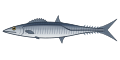
Size: Shoal fish are mostly 6–10 kg, and fish over 20 kg ("crocs") are caught every season. The SA angling record is 46.4 kg.
Where: Common in Mozambique and KZN, and only rarely as far south as Mossel Bay. The best KZN grounds run from the south coast to Sodwana, with the biggest fish between Richards Bay and Sodwana.
How to spot it
A long, streamlined silver fish with a blue-grey back and many thin, wavy dark bars on the sides. The first dorsal fin is short and low, and the lateral line drops sharply under the end of the second dorsal fin. A row of finlets runs in front of the crescent-shaped tail, and the mouth is full of sharp teeth.
Varieties and look-alikes
-
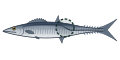 King Mackerel - Short first dorsal fin, many thin wavy bars, and a lateral line that drops sharply under the second dorsal fin.
-
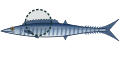 Wahoo - A long, spiny first dorsal fin that starts right behind the head, a beak-like snout and bold blue bars.
What it eats
Couta hunt shoals of baitfish such as sardines, mackerel, shad, small tuna and wolf herring, and also take lizardfish and other small fish. They tend to hunt along one depth line, over reef or along sandy stretches between points.
Where it feeds
- Along depth lines of 10–40 m, often 15–30 m
- Over wrecks, pinnacles and shallow reefs
- Along colour lines where green and blue water meet
- On bait marks where baitfish gather
How to catch it
Slow-troll a live bait (mackerel, mozzie, shad or maasbanker) with the boat just in gear, about 1.5–2.5 km/h, or a dead bonnie, mackerel or walla walla. Rig it on a wire trace with treble hooks, because couta bite through nylon, and put a sinker a few metres ahead of the bait to keep it down. Trolled lures such as Rattlers and spoons also work, especially at sunrise.
| Way of fishing | How well it works |
|---|---|
| Bait on the bottomA sinker holds your bait still on the bottom. | Not used |
| Under a bobberA bobber is a small buoy on your line: it holds the bait off the bottom and dips under when a fish bites. | Sometimes |
| Natural or dead baitReal food on the hook: worms, liver, sardine, chokka. | Works well |
| Live baitA small live fish or other live creature on the hook. | Best |
| LuresArtificial baits you cast and reel in: spinners, spoons, plastics. | Works well |
| TrollingLures or bait pulled behind a moving boat. | Best |
| Fly fishingLight artificial flies, cast with a fly rod. | Sometimes |
Baits and lures that work
- Live baitfish
- Mackerel
- Fish strips or dead fish
- Sardine
- Crankbaits and plugs
- Spoons
Flavours it likes
- Fish
Fresh, oily baitfish work best: live mackerel or shad, or a dead bonnie or mackerel. Rig dead baits so they swim straight and do not spin.
When it bites
Time of day
| Time | Bite |
|---|---|
| Dawn | Best |
| Day | Good |
| Midday | Slow |
| Dusk | Good |
| Night | Rarely |
First light is the best time: shoal fish hit lures in the shallows and live baits get eaten. Later in the day, keep live baits down on the depth line where the fish are.
Best months
- Best: February, March, April, May
- Good: January, June, November, December
Couta move down from Mozambique in summer, and the KZN season runs from about December to June. February and March bring the shoal fish, and the big fish come in April and May, often just before the sardine run.
What affects the bite
| Condition | What it likes | Effect on the bite |
|---|---|---|
| Water temperature | Best at 23–27 °C | High |
| Time of day | Best at dawn and dusk | High |
| Tide | Hardly matters | Low |
| Swell and surf | Best when the sea is calm | Medium |
| Air pressure | Best when it is falling | Medium |
| Cloud cover | Best on overcast days | Low |
| Wind | Best with a light breeze | High |
| Rain | Best in dry weather | Medium |
| Water clarity | Best with a little colour in the water | Medium |
| Moon phase | Hardly matters | Low |
| Spawning | Feeds hard before and after spawning | Medium |
High means it makes a big difference to whether this fish bites. Low means it hardly matters.
Tips
- Troll as slowly as you can, and speed up now and then so the bait flutters.
- Find the depth where the fish are showing and stay on that line.
- Watch the water temperature: anglers find couta come on the bite at 23 °C and bite best at 24 °C and warmer.
Good to know: Couta teeth are razor sharp, so use long-nose pliers to unhook them. Check the current rules: the DFFE has listed a bag limit of 10 per person per day, with no minimum size.
Are they biting today?
BaitLine's fishing forecast scores today's conditions for King Mackerel hour by hour - free for everyone. Sign up free and get the whole Fishing guide in the app.