Yellowtail
Seriola lalandi
A hard-fighting Cape shoal fish that hunts sardines and squid, caught from boats on spinners, jigs, poppers and bait.
Size: Most yellowtail caught at Cape Point weigh 2–5 kg, and fish up to 12 kg are not uncommon. Fish over 20 kg are rare.
Where: Found from Namibia to northern KZN, but most common in Cape waters: Cape Point, False Bay and the west coast up to Hondeklip Bay. In winter some shoals follow the sardines up the east coast to KZN.
How to spot it
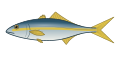
A strong, torpedo-shaped fish with a blue-green back, silver sides and a white belly. A brassy yellow stripe runs from the eye to the tail, and the tail and fins are bright yellow. The tail is deeply forked, and unlike a kingfish it has no hard scutes near the tail.
What it eats
Yellowtail hunt shoals of sardine, horse mackerel, anchovy and mackerel, plus squid and crustaceans. They often drive the bait to the surface, where terns, gannets and gulls dive on it.
Where it feeds
- Under diving birds, especially terns, around Cape Point
- Over reefs and pinnacles with deep water around them, like Bellows Rock, the Anvil and Rocky Bank
- Along the edge of the kelp beds inside Cape Point
- Offshore banks, and KZN reefs in winter
How to catch it
Find the fish by looking for working birds, then cast a spinner or popper past the shoal and pull it through, rather than into the middle. When the birds leave, find the shoal on the sounder and drop a metal jig down to it. Chokka or sardine on a 9/0 hook with a 1 m trace and little or no sinker also works well. A 5000-size spinning reel with braid suits casting; use heavier gear for deep jigging.
| Way of fishing | How well it works |
|---|---|
| Bait on the bottomA sinker holds your bait still on the bottom. | Sometimes |
| Under a bobberA bobber is a small buoy on your line: it holds the bait off the bottom and dips under when a fish bites. | Sometimes |
| Natural or dead baitReal food on the hook: worms, liver, sardine, chokka. | Works well |
| Live baitA small live fish or other live creature on the hook. | Works well |
| LuresArtificial baits you cast and reel in: spinners, spoons, plastics. | Best |
| TrollingLures or bait pulled behind a moving boat. | Works well |
| Fly fishingLight artificial flies, cast with a fly rod. | Sometimes |
Baits and lures that work
- Metal jigs
- Topwater lures and poppers
- Chokka (squid)
- Sardine
- Live baitfish
- Crankbaits and plugs
- Skirted trolling lures
Flavours it likes
- Squid
- Fish
Chokka is the top bait, then sardine and fresh pieces of fish. With lures, size and shape matter more: match the size of the bait they are eating.
When it bites
Time of day
| Time | Bite |
|---|---|
| Dawn | Best |
| Day | Good |
| Midday | Slow |
| Dusk | Good |
| Night | Rarely |
Be on the water at sunrise. The birds often scatter by mid-morning and the bite slows, and yellowtail are seldom caught at night.
Best months
- Best: January, February, March, November, December
- Good: April, May, June, July, August, September, October
Summer is the main season around Cape Point and False Bay, from about November to April. On the west coast the season usually starts in winter, around July, and in KZN yellowtail turn up with the sardine run.
What affects the bite
| Condition | What it likes | Effect on the bite |
|---|---|---|
| Water temperature | Best at 15–22 °C | High |
| Time of day | Best at dawn and dusk | High |
| Tide | Hardly matters | Low |
| Swell and surf | Best when the sea is calm | Medium |
| Air pressure | Best when it is falling | Medium |
| Cloud cover | Best on clear days | Low |
| Wind | Best with a light breeze | High |
| Rain | Best in dry weather | Low |
| Water clarity | Best in clear water | High |
| Moon phase | Hardly matters | Low |
| Spawning | Hardly changes | Low |
High means it makes a big difference to whether this fish bites. Low means it hardly matters.
Tips
- Look for terns (sterretjies) working the water: yellowtail are usually right under them.
- Some days they take only one lure, so carry a few different spinners and poppers.
- Bring a hooked fish in quickly: seals around Cape Point often take yellowtail off the line.
Good to know: Check the current rules: the DFFE has listed a bag limit of 10 yellowtail per person per day, with no minimum size.
Are they biting today?
BaitLine's fishing forecast scores today's conditions for Yellowtail hour by hour - free for everyone. Sign up free and get the whole Fishing guide in the app.