
Giant Trevally
Caranx ignobilis
The biggest and toughest kingfish, a top predator of KZN and Mozambique reefs and estuaries, caught on poppers and live bait.
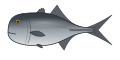
Size: Young fish in estuaries are mostly under 60 cm; they mature at about 60–65 cm fork length. The biggest in the world reach about 80 kg.
Where: From Algoa Bay northwards, but mainly KZN and Mozambique, and more common off KZN in summer. Young fish grow up in KZN estuaries such as Kosi Bay and St Lucia, and in the surf of northern KZN and Mozambique.
How to spot it
A deep, powerful kingfish with a steep, blunt head, a big mouth and a deeply forked, sickle-shaped tail. Adults are dark grey to silver-grey, with big fish sometimes almost black. A row of hard, bony scutes runs along the narrow part of the tail.
What it eats
Mostly fish, about 70% of its food, plus squid, mantis shrimps and other crustaceans. It hunts baitfish along reef edges, channels and river mouths.
Where it feeds
- Shallow reefs, reef edges and drop-offs with current
- Estuary mouths and channels, especially young fish
- The surf and rocky points of northern KZN and Mozambique
- Following baitfish shoals, including the sardine run
How to catch it
From a boat, cast big poppers and stickbaits over shallow reef and work them hard and fast across the surface. Slow-trolled or drifted live baits such as mackerel or mullet also work well. From the shore, live bait fished off rocky points and at estuary mouths catches the big ones, while small poppers, spoons and crankbaits catch young kingfish in estuaries and harbours. Use strong braid, a heavy leader and a tight drag: a GT runs straight for the reef.
| Way of fishing | How well it works |
|---|---|
| Bait on the bottomA sinker holds your bait still on the bottom. | Not used |
| Under a bobberA bobber is a small buoy on your line: it holds the bait off the bottom and dips under when a fish bites. | Not used |
| Natural or dead baitReal food on the hook: worms, liver, sardine, chokka. | Sometimes |
| Live baitA small live fish or other live creature on the hook. | Best |
| LuresArtificial baits you cast and reel in: spinners, spoons, plastics. | Best |
| TrollingLures or bait pulled behind a moving boat. | Works well |
| Fly fishingLight artificial flies, cast with a fly rod. | Works well |
Baits and lures that work
- Topwater lures and poppers
- Live baitfish
- Live mullet (harders)
- Crankbaits and plugs
- Metal jigs
- Spoons
- Streamers and baitfish flies
Flavours it likes
GTs hunt by sight and vibration, so scent does not matter. What draws them is a lure that splashes and pops on the surface, or a lively live bait.
When it bites
Time of day
| Time | Bite |
|---|---|
| Dawn | Best |
| Day | Good |
| Midday | Slow |
| Dusk | Best |
| Night | Slow |
First and last light are best, and a bright, calm midday is usually slow. Overcast days can keep them biting all day.
Best months
- Best: January, February, March, October, November, December
- Good: April, May, June, July, August, September
Summer is GT time: adults are most common off KZN and southern Mozambique from about October to April, when the water is warm. Big adults gather in shoals in early summer (October to December), and young fish move into KZN estuaries in summer.
What affects the bite
| Condition | What it likes | Effect on the bite |
|---|---|---|
| Water temperature | Best at 24–29 °C | Medium |
| Time of day | Best at dawn and dusk | High |
| Tide | Best on the incoming tide | Medium |
| Swell and surf | Best with some swell | Medium |
| Air pressure | Best when it is falling | High |
| Cloud cover | Best on overcast days | High |
| Wind | Best with a light breeze | High |
| Rain | Best in dry weather | Medium |
| Water clarity | Hardly matters | Low |
| Moon phase | Hardly matters | Low |
| Spawning | Feeds hard before and after spawning | Medium |
High means it makes a big difference to whether this fish bites. Low means it hardly matters.
Tips
- Fish moving water: reef edges and channels where the tide runs give you the best chance.
- Use a heavy leader and set your drag tight; a hooked GT dives straight for the reef.
- Big GTs are trophy fish and most are released. Keep them in the water while you take the hook out and take photos.
Good to know: Check the current rules: kingfish (all Caranx and Carangoides species together) have a daily bag limit of 5 per person and no minimum size, and you may not sell them. Shoals of big adults gather at the Mtentu River mouth, inside the Pondoland no-take zone.
Are they biting today?
BaitLine's fishing forecast scores today's conditions for Giant Trevally hour by hour - free for everyone. Sign up free and get the whole Fishing guide in the app.