
Queenfish
Scomberoides commersonnianus
A silver, leather-skinned KZN game fish that hunts small baitfish around reefs, harbours and estuary mouths, and takes fast lures and live bait.
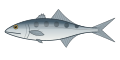
Size: Largemouth queenfish can reach about 120 cm and 16 kg. The needlescaled queenfish stays much smaller.
Where: From Algoa Bay north to Mozambique, widespread but nowhere common. Most are caught in KZN, around St Lucia, Richards Bay, Durban Bay and South Coast reefs such as Aliwal Shoal.
How to spot it
A long, flat-sided silver fish with a blue-grey back, a deeply forked tail and a row of dark blotches along the upper side. The largemouth (talang) queenfish, the main one in KZN, has a mouth that reaches well behind the eye. The smaller needlescaled queenfish has upright oval blotches that cross the lateral line.
Varieties and look-alikes
-
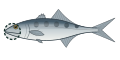 Largemouth (talang) queenfish - A big mouth that reaches well behind the eye, and round blotches above the lateral line.
-
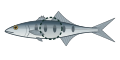 Needlescaled queenfish - A slimmer fish with a smaller mouth and upright oval blotches that cross the lateral line.
-
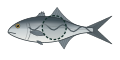 Garrick - No blotches: the lateral line runs in a clear wavy line along the side.
What it eats
Adults eat small fish from mid-water and the bottom, plus mantis shrimps, swimming crabs and squid. Young queenfish feed on the scales of other fish.
Where it feeds
- Estuary mouths, harbours and bays, such as Durban Bay, Richards Bay and St Lucia
- Over shallow reefs and around reef pinnacles
- Just behind the backline in 5–8 m of water
- Wherever baitfish shoals are pushed up to the surface
How to catch it
Cast spoons, poppers, stickbaits or swimming plugs and wind them in fast, or troll a swimming plug slowly behind a ski or boat. A small live baitfish such as a maasbanker, mullet or mackerel on a light leader works well, and fish strips also catch them. Queenfish often jump when hooked, so keep the line tight.
| Way of fishing | How well it works |
|---|---|
| Bait on the bottomA sinker holds your bait still on the bottom. | Not used |
| Under a bobberA bobber is a small buoy on your line: it holds the bait off the bottom and dips under when a fish bites. | Not used |
| Natural or dead baitReal food on the hook: worms, liver, sardine, chokka. | Sometimes |
| Live baitA small live fish or other live creature on the hook. | Works well |
| LuresArtificial baits you cast and reel in: spinners, spoons, plastics. | Best |
| TrollingLures or bait pulled behind a moving boat. | Works well |
| Fly fishingLight artificial flies, cast with a fly rod. | Sometimes |
Baits and lures that work
- Spoons
- Topwater lures and poppers
- Live baitfish
- Crankbaits and plugs
- Soft plastics
- Fish strips or dead fish
Flavours it likes
Queenfish chase what moves. Flash, speed and a lively bait draw them far better than any scent.
When it bites
Time of day
| Time | Bite |
|---|---|
| Dawn | Best |
| Day | Good |
| Midday | Slow |
| Dusk | Good |
| Night | Rarely |
Queenfish feed in daylight, with the best spells early and late in the day. They are seldom caught at night.
Best months
- Best: January, February, March, November, December
- Good: April, May, September, October
Queenfish are most common in KZN in summer, from about November to March. In winter they turn up now and then with other game fish.
What affects the bite
| Condition | What it likes | Effect on the bite |
|---|---|---|
| Water temperature | Best at 22–28 °C | Medium |
| Time of day | Best at dawn and dusk | Medium |
| Tide | Hardly matters | Low |
| Swell and surf | Best with some swell | Medium |
| Air pressure | Best when steady or falling | Medium |
| Cloud cover | Best on clear days | Low |
| Wind | Best with a light breeze | High |
| Rain | Best in dry weather | Medium |
| Water clarity | Hardly matters | Low |
| Moon phase | Hardly matters | Low |
| Spawning | Hardly changes | Low |
High means it makes a big difference to whether this fish bites. Low means it hardly matters.
Tips
- Look for baitfish being pushed to the surface near reefs and river mouths, and cast there.
- Keep the rod tip low and the line tight when a queenfish jumps, so it cannot throw the hook.
- Hold the fish carefully: the spines on the back and belly can give a nasty prick.
Good to know: Check the current rules: queenfish are not on the species list, so the general limit of 10 fish per person per day for unlisted species applies. Mind the sharp spines in front of the dorsal and anal fins when you handle them.
Are they biting today?
BaitLine's fishing forecast scores today's conditions for Queenfish hour by hour - free for everyone. Sign up free and get the whole Fishing guide in the app.