
Barracuda
Sphyraena barracuda, S. jello
A long, silver ambush hunter with fang-like teeth, caught on lures and live bait in KZN harbours, estuaries and northern reefs.
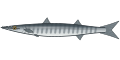
Size: Pickhandle in Durban harbour are mostly 0.5–3 kg, and they reach about 1.5 m. Great barracuda grow bigger, to about 1.8 m.
Where: Pickhandle are common in KZN harbours, estuaries and inshore reefs, and stray as far south as Knysna. Great barracuda live mainly from northern KZN into Mozambique, over reefs, and their young grow up in estuaries such as Kosi Bay.
How to spot it
A long, round, silver fish with a pointed head, a jutting lower jaw and big, fang-like teeth. It has two small dorsal fins set far apart and a forked tail. The pickhandle has dark bars that run down across the middle of its side and a yellowish tail; the great barracuda has short dark bars on the upper back, black blotches lower down and a dark tail. In KZN, 'cuda' or 'couta' usually means king mackerel, which is a different fish.
Varieties and look-alikes
-
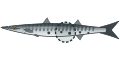 Great barracuda - Short dark bars on the upper back only, black blotches lower down the side and a dark tail.
-
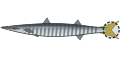 Pickhandle barracuda - Dark bars run down across the middle of the side, and the tail is yellowish.
-
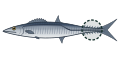 King Mackerel - A row of small finlets in front of the tail and a lateral line that drops sharply; a barracuda has no finlets.
What it eats
Mostly fish, such as harders, halfbeaks, small kingfish and other baitfish, and also squid. A barracuda hangs still, then strikes in a sudden, fast rush.
Where it feeds
- Harbour walls, jetties, moorings and sandbanks, such as in Durban harbour
- Estuaries and river mouths with clean water
- Inshore and deeper reefs from northern KZN into Mozambique
- Wherever shoals of small baitfish gather
How to catch it
From the shore or a small boat, cast spoons, jerkbaits, small paddletail soft plastics and poppers, and wind them back slowly. From a ski-boat, slow-troll a live bait or a diving lure over the reefs. Use a short wire trace or a thick fluorocarbon leader, because the teeth cut through nylon.
| Way of fishing | How well it works |
|---|---|
| Bait on the bottomA sinker holds your bait still on the bottom. | Sometimes |
| Under a bobberA bobber is a small buoy on your line: it holds the bait off the bottom and dips under when a fish bites. | Sometimes |
| Natural or dead baitReal food on the hook: worms, liver, sardine, chokka. | Sometimes |
| Live baitA small live fish or other live creature on the hook. | Best |
| LuresArtificial baits you cast and reel in: spinners, spoons, plastics. | Best |
| TrollingLures or bait pulled behind a moving boat. | Works well |
| Fly fishingLight artificial flies, cast with a fly rod. | Sometimes |
Baits and lures that work
- Live baitfish
- Live mullet (harders)
- Spoons
- Crankbaits and plugs
- Soft plastics
- Topwater lures and poppers
- Sardine
Flavours it likes
Barracuda hunt by sight. Flash, a lively bait and clean water draw them, not scent.
When it bites
Time of day
| Time | Bite |
|---|---|
| Dawn | Best |
| Day | Good |
| Midday | Slow |
| Dusk | Best |
| Night | Slow |
Early morning and late afternoon are best, and harbour fish keep biting into the evening. The middle of a bright day is slower.
Best months
- Best: January, February, March, November, December
- Good: April, May, June, July, August, September, October
Barracuda are caught all year in KZN. November to March is best, when they spawn and great barracuda are most common in the north.
What affects the bite
| Condition | What it likes | Effect on the bite |
|---|---|---|
| Water temperature | Best at 21–28 °C | Medium |
| Time of day | Best at dawn and dusk | Medium |
| Tide | Best around high tide | Medium |
| Swell and surf | Best when the sea is calm | Medium |
| Air pressure | Best when it is falling | Medium |
| Cloud cover | Hardly matters | Low |
| Wind | Best when it is calm | Medium |
| Rain | Best in dry weather | High |
| Water clarity | Best in clear water | High |
| Moon phase | Hardly matters | Low |
| Spawning | Hardly changes | Low |
High means it makes a big difference to whether this fish bites. Low means it hardly matters.
Tips
- Keep your fingers away from the mouth: unhook barracuda with long-nose pliers.
- Poppers work best on calm days, when the fish can see them clearly.
- In Durban harbour, fish the sandbanks on the high tide.
Good to know: The teeth cut deep, so use a gaff or a big net and never hold a barracuda by the mouth. In some tropical areas big great barracuda can carry ciguatera, a fish poison, so be careful about eating large ones. Check the current rules: barracuda are not listed on their own, so the general DFFE bag limit of 10 fish per person per day applies, and no fishing is allowed in the sanctuary zones of the iSimangaliso marine protected area.
Are they biting today?
BaitLine's fishing forecast scores today's conditions for Barracuda hour by hour - free for everyone. Sign up free and get the whole Fishing guide in the app.