
Cornish Jack
Mormyrops anguilloides
The biggest of the elephantfish: a long, slim night hunter of the Zambezi and Kariba, usually a bonus catch on fillet, kapenta or worms.
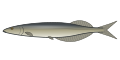
Size: Most fish caught are 3 kg or more. It can reach 1.5 m and 15 kg.
Where: In Southern Africa only the middle and lower Zambezi, including Kariba and Cahora Bassa, and the Pungwe and Buzi in Mozambique. Further north it lives in Lakes Malawi and Tanganyika and many tropical African rivers.
How to spot it
A long, slim body with a long head, a rounded snout, small eyes and a mouth at the tip with small teeth. The anal fin is much longer than the dorsal fin and starts in front of it, and both sit far back near a forked tail on a thin tail stem. Adults are grey above and silvery white below, often with a bronze or yellow sheen; young fish are darker.
Varieties and look-alikes
-
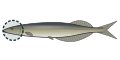 Cornish Jack - Long and slim like a pike, with a long head and snout and no lump on the chin.
-
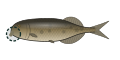 Bulldog - Short and small, with a fleshy lump on the chin that sticks out past the upper jaw.
What it eats
Young fish eat shrimps and insect larvae; adults hunt small fish such as kurper, minnows and young labeos. It hunts at night in small groups and finds prey with a weak electric field rather than its eyes.
Where it feeds
- Deep holes in the river bed or lake where food collects, often near floating weed edges
- Deep, quiet water among boulders and under overhangs, away from strong current
- Under floating weed mats and in river mouths in Kariba
- The shallows at night, when it comes in to hunt
How to catch it
Fish deep holes on the bottom by day and the shallows at night. In strong current use a running sinker rig with a fairly heavy sinker so the bait can move a little; in still water a plain sinker holds the bait on the bottom. Bait up with a strip of fish fillet, kapenta, worms or a small frog. It usually gives two gentle pulls before it runs, so wait for the run before you strike.
| Way of fishing | How well it works |
|---|---|
| Bait on the bottomA sinker holds your bait still on the bottom. | Best |
| Under a bobberA bobber is a small buoy on your line: it holds the bait off the bottom and dips under when a fish bites. | Not used |
| Pap, mielies, boilies and floatsSweet baits on the hook (pap, mielies, boilies or floats), with more thrown in around them. | Not used |
| Natural or dead baitReal food on the hook: worms, liver, sardine, chokka. | Best |
| Live baitA small live fish or other live creature on the hook. | Sometimes |
| LuresArtificial baits you cast and reel in: spinners, spoons, plastics. | Not used |
| Fly fishingLight artificial flies, cast with a fly rod. | Not used |
Baits and lures that work
- Fish strips or dead fish
- Kapenta
- Earthworms
- Small frogs
- Freshwater crabs
Flavours it likes
Fresh bait matters more than any flavour. Use fresh fillet, kapenta or worms, and change baits that have washed out.
When it bites
Time of day
| Time | Bite |
|---|---|
| Dawn | Good |
| Day | Slow |
| Midday | Rarely |
| Dusk | Best |
| Night | Best |
Dusk and the first hours of darkness are best, when it moves into the shallows to hunt. In the day it is mostly caught in deep holes.
Best months
- Best: March, April, October, November
- Good: January, February, May, August, September, December
October–November, before the rains, and March–April are good. Muddy water after rain can help, because it then hunts in shallower holes. It slows down in the cold winter months.
What affects the bite
| Condition | What it likes | Effect on the bite |
|---|---|---|
| Water temperature | Best at 22–31 °C | High |
| Time of day | Best at night | High |
| Air pressure | Best when it is falling | Medium |
| Cloud cover | Best on overcast days | Low |
| Wind | Best with a light breeze | Low |
| Rain | Best after rain | Medium |
| Water clarity | Best in murky water | Low |
| Moon phase | Best around new moon | Low |
| Spawning | Hardly changes | Low |
High means it makes a big difference to whether this fish bites. Low means it hardly matters.
Tips
- When you catch one, keep fishing the same hole: they hunt in small groups.
- Lift it off the bottom quickly: it sulks deep and is hard to get up.
- If the squeakers suddenly stop biting in a pool, a Cornish jack or tigerfish may have moved in, so try a fillet bait.
Good to know: It gives a mild electric shock when you lift it by the head and tail together. It is valued as a good eating fish.
Are they biting today?
BaitLine's fishing forecast scores today's conditions for Cornish Jack hour by hour - free for everyone. Sign up free and get the whole Fishing guide in the app.