
Nkupe
Distichodus mossambicus
The chessa's darker, slimmer river cousin: a powerful fighter of the Zambezi's fast water, caught on worms, fish fillet and kapenta.
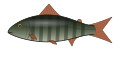
Size: Most are under 3 kg, and fish over 2.5 kg are scattered and scarce. They grow to about 7.5 kg.
Where: The middle and lower Zambezi below Victoria Falls, including Kariba and Cahora Bassa, and the Pungwe and Buzi in Mozambique. It lives mainly in the main channel of big rivers; in Kariba it is found mostly in the west where the Zambezi flows in, and numbers there have dropped since the dam was built.
How to spot it
A deep but more streamlined body than the chessa, with a longer snout and the mouth at the tip. Adults are dark olive, almost black, and big fish look black. Young fish are silvery with 6–7 broad dark bars. It has rough scales, a long dorsal fin and a small fatty fin near the tail.
Varieties and look-alikes
-
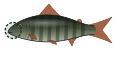 Nkupe - Dark olive, almost black, and slimmer, with a longer snout and the mouth right at the tip.
-
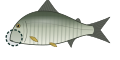 Chessa - Silvery olive and deep-bodied, with a short snout and the mouth tucked underneath.
What it eats
It eats insects, snails, small fish and water plants, so it takes more meat than the chessa. Big fish cruise the river channels for food, while smaller fish shoal around fallen trees and rocks.
Where it feeds
- Fast water, rapids and the runs below them
- Deep, quiet pools with sand or rock bottoms in the main river
- Fallen trees and rocks, where smaller fish shoal
- Sandy runs where the Zambezi enters Kariba
How to catch it
For smaller shoaling fish, anchor above a fallen tree and cast downstream with a running sinker rig, a sinker heavy enough to hold and a small hook with worms. For big fish, drift down the river with a small strip of fish fillet. In Kariba they are sometimes caught on a spinner by anglers fishing for bream or small tigerfish.
| Way of fishing | How well it works |
|---|---|
| Bait on the bottomA sinker holds your bait still on the bottom. | Best |
| Under a bobberA bobber is a small buoy on your line: it holds the bait off the bottom and dips under when a fish bites. | Not used |
| Pap, mielies, boilies and floatsSweet baits on the hook (pap, mielies, boilies or floats), with more thrown in around them. | Not used |
| Natural or dead baitReal food on the hook: worms, liver, sardine, chokka. | Best |
| Live baitA small live fish or other live creature on the hook. | Sometimes |
| LuresArtificial baits you cast and reel in: spinners, spoons, plastics. | Sometimes |
| Fly fishingLight artificial flies, cast with a fly rod. | Not used |
Baits and lures that work
- Earthworms
- Fish strips or dead fish
- Kapenta
- Spinners
Flavours it likes
No flavours needed. Use fresh worms for smaller fish, and a fresh strip of fillet or kapenta for bigger ones.
When it bites
Time of day
| Time | Bite |
|---|---|
| Dawn | Best |
| Day | Good |
| Midday | Slow |
| Dusk | Best |
| Night | Slow |
Early morning and late afternoon are best, with slower bites through the day. Night fishing is slow.
Best months
- Best: April, September, October
- Good: January, February, March, May, August, November, December
September–October, before the rains, and April, after the floods, fish best. In the rains they run upstream to breed and the river turns muddy, and in the cold winter months they slow down.
What affects the bite
| Condition | What it likes | Effect on the bite |
|---|---|---|
| Water temperature | Best at 23–31 °C | High |
| Time of day | Best at dawn and dusk | Medium |
| Air pressure | Best when it is falling | Medium |
| Cloud cover | Best on overcast days | Low |
| Wind | Best with a light breeze | Medium |
| Rain | Best in dry weather | Low |
| Water clarity | Hardly matters | Low |
| Moon phase | Hardly matters | Low |
| Spawning | Feeds hard before and after spawning | Medium |
High means it makes a big difference to whether this fish bites. Low means it hardly matters.
Tips
- Use a strong rod and set your drag before you cast: a big nkupe in the current pulls very hard.
- If a big fish runs downstream, follow it with the boat instead of trying to stop it.
- Worms catch more fish, but a fillet strip picks out the bigger ones.
Good to know: Check the current rules: Zambia has a yearly fish ban from 1 December to 28 February on rivers such as the Zambezi and Kafue.
Are they biting today?
BaitLine's fishing forecast scores today's conditions for Nkupe hour by hour - free for everyone. Sign up free and get the whole Fishing guide in the app.