
Chessa
Distichodus schenga
A deep-bodied, hard-fighting Zambezi fish with a tiny mouth, caught mostly on worms in the river and now and then in Lake Kariba.
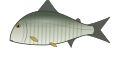
Size: Most are under 2 kg, but they grow to just over 6 kg.
Where: The middle and lower Zambezi below Victoria Falls, including Kariba, the Lower Zambezi and Cahora Bassa, and the Pungwe and Buzi rivers in Mozambique. It is a river fish: most common in the Zambezi itself, and only caught now and then in Kariba.
How to spot it
A deep body, flat from side to side, with a steep forehead and a small, pointed head. The short snout has a small mouth underneath it. Adults are silvery olive with sooty grey dorsal, anal and tail fins, and yellowish pectoral and pelvic fins. Young fish have 12–16 thin, faint dark bars and a dark spot at the base of the tail.
Varieties and look-alikes
-
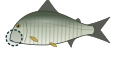 Chessa - Silvery olive and deep-bodied, with a short snout and the mouth tucked underneath.
-
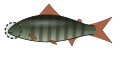 Nkupe - Dark olive, almost black, and slimmer, with a longer snout and the mouth right at the tip.
What it eats
It eats mostly algae and plant matter, plus insects, worms, snails, shrimps and small fish. In the river, shoals sit behind hippos, islands and fallen trees and pick off food that drifts down in the current, including food in hippo dung.
Where it feeds
- Eddies behind islands, fallen trees and hippo pods, where the current is fairly strong
- Gravel banks with choppy water in Kariba
- Shallow water near hippo pods in Kariba
- Big rivers over rock and sand bottoms
How to catch it
Anchor just behind or beside an island, fallen tree or hippo pod (keep your distance from the hippos) and cast downstream into the current. Use a sinker heavy enough to hold the bait on the bottom, and a small hook (about size 8–12) with one or two worms. Bites are very quick, so hold the rod and strike fast.
| Way of fishing | How well it works |
|---|---|
| Bait on the bottomA sinker holds your bait still on the bottom. | Best |
| Under a bobberA bobber is a small buoy on your line: it holds the bait off the bottom and dips under when a fish bites. | Not used |
| Pap, mielies, boilies and floatsSweet baits on the hook (pap, mielies, boilies or floats), with more thrown in around them. | Not used |
| Natural or dead baitReal food on the hook: worms, liver, sardine, chokka. | Best |
| Live baitA small live fish or other live creature on the hook. | Not used |
| LuresArtificial baits you cast and reel in: spinners, spoons, plastics. | Not used |
| Fly fishingLight artificial flies, cast with a fly rod. | Not used |
Baits and lures that work
- Earthworms
- Fish strips or dead fish
Flavours it likes
Chessa aren't caught on flavoured baits. Fresh, lively worms draw them; keep your worms cool and rebait often, because chessa strip a hook fast.
When it bites
Time of day
| Time | Bite |
|---|---|
| Dawn | Best |
| Day | Best |
| Midday | Good |
| Dusk | Best |
| Night | Slow |
Chessa feed in daylight, best from early morning, and keep biting through the day. They are seldom caught at night.
Best months
- Best: April, September, October
- Good: January, February, March, May, August, November, December
September–October, before the rains, and April, after the floods, fish best. In the rains they run upstream to breed and the river turns muddy, and in the cold winter months they slow down.
What affects the bite
| Condition | What it likes | Effect on the bite |
|---|---|---|
| Water temperature | Best at 22–31 °C | High |
| Time of day | Best during the day | Medium |
| Air pressure | Best when it is falling | Medium |
| Cloud cover | Best on overcast days | Low |
| Wind | Best with a light breeze | Medium |
| Rain | Best in dry weather | Low |
| Water clarity | Hardly matters | Low |
| Moon phase | Hardly matters | Low |
| Spawning | Feeds hard before and after spawning | Medium |
High means it makes a big difference to whether this fish bites. Low means it hardly matters.
Tips
- Fish behind the boat, not to the side: the shoal sits in the eddy behind the cover, so that's where your bait must land.
- Carry long-nose pliers: chessa have small mouths and often swallow the hook.
- Set your drag before you cast. They fight hard for their size and use the current.
Good to know: Chessa often swallow the hook and bleed easily, so they don't release well; keep only what you need. Check the current rules: Zambia has a yearly fish ban from 1 December to 28 February on rivers such as the Zambezi and Kafue.
Are they biting today?
BaitLine's fishing forecast scores today's conditions for Chessa hour by hour - free for everyone. Sign up free and get the whole Fishing guide in the app.