Clanwilliam Yellowfish
Labeobarbus seeberi
A rare, protected yellowfish found only in the Olifants-Doring rivers of the Western Cape: a shy, prized fly-rod fish that you must release.
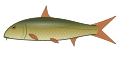
Size: Most fish caught are 20–40 cm. The biggest on record was 98.7 cm and 10.7 kg, and the SA angling record is 5.7 kg.
Where: Only in the Olifants-Doring system around Clanwilliam: the Doring, Biedouw, Rondegat, Twee and other Cederberg rivers, and a few dams in the area. Many stretches no longer hold fish because of alien bass and water taken from the rivers.
How to spot it
A golden to olive-brown yellowfish with a small mouth under the snout and thick lips. Young fish are silvery with dark blotches on the sides, and adults turn golden, breeding males most of all. The only other big barb in its rivers is the Clanwilliam sawfin, which has a saw-edged spine in its dorsal fin.
Varieties and look-alikes
-
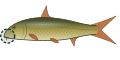 Clanwilliam Yellowfish - A small mouth under the snout with thick lips, and it lives only in the Olifants-Doring rivers of the Western Cape.
-
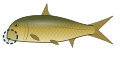 Smallmouth Yellowfish - A short, rounded snout with a small mouth underneath that opens downwards.
-
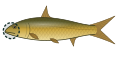 Largemouth Yellowfish - A long head with a big mouth right at the tip of the snout that opens forwards.
What it eats
An omnivore: insect nymphs, crabs, tadpoles, frogs and small fish, plus algae and soft plants. Groups of 4–10 fish often feed together.
Where it feeds
- Long, deep pools with rock ledges and plants
- Fast runs and riffles near rapids, mainly in spring and autumn
- Pool edges, where you can spot fish in the clear water
How to catch it
Sight fishing with a fly is the main method: a 5 or 6 weight rod, a long leader and the lightest tippet you can get away with. Cast a few metres ahead of a fish and watch how it reacts; drift nymphs through runs and fish small streamers through deep pools. Small spinners and soft plastics also catch them. Keep low and false-cast as little as you can, as they spook easily.
| Way of fishing | How well it works |
|---|---|
| Bait on the bottomA sinker holds your bait still on the bottom. | Sometimes |
| Under a bobberA bobber is a small buoy on your line: it holds the bait off the bottom and dips under when a fish bites. | Not used |
| Pap, mielies, boilies and floatsSweet baits on the hook (pap, mielies, boilies or floats), with more thrown in around them. | Not used |
| Natural or dead baitReal food on the hook: worms, liver, sardine, chokka. | Sometimes |
| Live baitA small live fish or other live creature on the hook. | Not used |
| LuresArtificial baits you cast and reel in: spinners, spoons, plastics. | Works well |
| Fly fishingLight artificial flies, cast with a fly rod. | Best |
Baits and lures that work
- Nymphs
- Streamers and baitfish flies
- Spinners
- Soft plastics
Flavours it likes
Flavour plays no part, since it is caught on flies and small lures. Natural-looking nymphs, dragonfly and damselfly patterns and small Woolly Buggers work best; a drab or clear line spooks it less than a bright one.
When it bites
Time of day
| Time | Bite |
|---|---|
| Dawn | Best |
| Day | Good |
| Midday | Slow |
| Dusk | Best |
| Night | Rarely |
Early morning and evening are best, but you need good light to spot the fish, so mid-morning works well too. It hardly feeds after dark.
Best months
- Best: March, April
- Good: January, February, May, September, October, December
Autumn (March and April) is best, when the water is low and clear. September can be good before the spawn, but from October to January the fish spawn; leave them alone in November, the main spawning month. Winter brings cold, high water.
What affects the bite
| Condition | What it likes | Effect on the bite |
|---|---|---|
| Water temperature | Best at 15–23 °C | High |
| Time of day | Best at dawn and dusk | Medium |
| Air pressure | Best when it is falling | High |
| Cloud cover | Best on overcast days | Medium |
| Wind | Best with a light breeze | Medium |
| Rain | Best in dry weather | High |
| Water clarity | Best in clear water | High |
| Moon phase | Hardly matters | Low |
| Spawning | Feeds hard before and after spawning | Medium |
High means it makes a big difference to whether this fish bites. Low means it hardly matters.
Tips
- Ask before you go whether the stretch still holds yellowfish; many no longer do.
- Watch the fish, not your line: if it swims away, go to a smaller fly and a thinner tippet.
- Use a barbless hook and keep the fish in the water for the photo and the release.
Good to know: Check the current rules: CapeNature requires catch and release for Clanwilliam yellowfish and all indigenous fish, and you need a CapeNature angling licence for rivers and public dams. It is a threatened species, so handle it gently.
Are they biting today?
BaitLine's fishing forecast scores today's conditions for Clanwilliam Yellowfish hour by hour - free for everyone. Sign up free and get the whole Fishing guide in the app.