Smallmouth Yellowfish
Labeobarbus aeneus
A hard-fighting, golden yellowfish of the Orange-Vaal system, loved by fly anglers and also caught on mielies and worms.
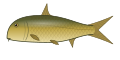
Size: Most are 20–45 cm and 0.5–2 kg. Big fish reach about 50 cm, and the SA angling record is 7.8 kg.
Where: Native to the Orange-Vaal system, including the Vaal, Orange and Kraai rivers and Sterkfontein Dam. It has also been stocked into the Gouritz, Great Fish and Kei rivers and the Olifants River in the Limpopo system.
How to spot it
A golden-olive fish with a short, rounded snout and a small mouth set underneath it. Press the lower lip down and the mouth opens downwards. The lips vary: some fish have thin lips, others thick, rubbery ones. Its eyes sit on the sides of the head, so you can see them when you look at the fish from below.
Varieties and look-alikes
-
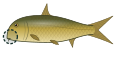 Smallmouth Yellowfish - A short, rounded snout with a small mouth underneath that opens downwards.
-
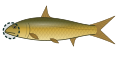 Largemouth Yellowfish - A long head with a big mouth right at the tip of the snout that opens forwards.
-
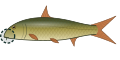 Clanwilliam Yellowfish - A small mouth under the snout with thick lips, and it lives only in the Olifants-Doring rivers of the Western Cape.
What it eats
An omnivore that feeds mostly on the bottom: insect nymphs and larvae, freshwater shrimps, crabs, snails and small mussels, plus algae and the odd small fish. It also rises to hatching insects on the surface.
Where it feeds
- Fast, shallow riffles and runs
- Current seams and shallow gravel bars
- Pool tails, where it rises to insects in summer
- Deep pools and slow water near the bottom in winter
How to catch it
On rivers, nymph fishing is the top method: drift a weighted nymph close to the bottom through riffles and runs on a 5 or 6 weight rod, and switch to dry flies when fish rise in summer. Bait anglers do well with mielies, worms or a small crab on light line, a small hook and one split shot or no weight at all, so the bait rolls with the current. On dams, fish mielies or a worm on a light running sinker rig, or under a bobber.
| Way of fishing | How well it works |
|---|---|
| Bait on the bottomA sinker holds your bait still on the bottom. | Works well |
| Under a bobberA bobber is a small buoy on your line: it holds the bait off the bottom and dips under when a fish bites. | Works well |
| Pap, mielies, boilies and floatsSweet baits on the hook (pap, mielies, boilies or floats), with more thrown in around them. | Works well |
| Natural or dead baitReal food on the hook: worms, liver, sardine, chokka. | Works well |
| Live baitA small live fish or other live creature on the hook. | Not used |
| LuresArtificial baits you cast and reel in: spinners, spoons, plastics. | Sometimes |
| Fly fishingLight artificial flies, cast with a fly rod. | Best |
Baits and lures that work
- Nymphs
- Earthworms
- Sweetcorn
- Freshwater crabs
- Crickets, grasshoppers and other insects
- Dry flies
- Pap
- Bread
Flavours it likes
- Caramel
- Garlic
- Sweetcorn
Most fish are caught on plain, natural baits. On mielies, a sweet caramel dip or a garlic-flavoured floating bait is worth a try.
When it bites
Time of day
| Time | Bite |
|---|---|
| Dawn | Best |
| Day | Good |
| Midday | Slow |
| Dusk | Best |
| Night | Rarely |
In summer fish early morning and late afternoon; the evening is often best. In winter they feed around midday, when the water is warmest. They hardly feed at night.
Best months
- Best: March, April, October, November
- Good: January, February, May, September, December
September to April is the season, with October to November and March to April the best. Summer floods can make rivers too muddy to fish, and winter is slow.
What affects the bite
| Condition | What it likes | Effect on the bite |
|---|---|---|
| Water temperature | Best at 16–24 °C | High |
| Time of day | Best at dawn and dusk | Medium |
| Air pressure | Best when it is falling | High |
| Cloud cover | Best on overcast days | Medium |
| Wind | Best with a light breeze | Medium |
| Rain | Best in dry weather | Medium |
| Water clarity | Best in clear water | Medium |
| Moon phase | Hardly matters | Low |
| Spawning | Feeds hard before and after spawning | Medium |
High means it makes a big difference to whether this fish bites. Low means it hardly matters.
Tips
- Fish the fast water: smallmouth feed hard in riffles where food washes past.
- No bites? Fish deeper before you change your fly or bait.
- Use barbless hooks and keep the fish wet in the net for a quick release.
Good to know: Check the current rules: you need a provincial angling licence for public waters, and bag limits differ between provinces. Leave fish spawning on shallow gravel beds in peace.
Are they biting today?
BaitLine's fishing forecast scores today's conditions for Smallmouth Yellowfish hour by hour - free for everyone. Sign up free and get the whole Fishing guide in the app.