Largemouth Yellowfish
Labeobarbus kimberleyensis
South Africa's biggest scaled freshwater fish: a slow-growing, fish-eating yellowfish of the Orange-Vaal system that you release after a hard fight.
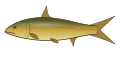
Size: Most fish caught are 40–70 cm, and fish over 5 kg are common. The SA angling record is 22.2 kg.
Where: Only in the Orange-Vaal system: big rivers such as the Vaal, Orange, Riet and Kraai, and large dams such as Vaal Dam, Sterkfontein and Vanderkloof. It is not found in small headwater streams.
How to spot it
A long, dull gold to bronze yellowfish with a long head and a big mouth right at the tip of the snout. Press the lower lip down and the mouth opens forwards, not down. Its eyes sit high on the head, so you cannot see them when you look at the fish from below. Small fish look almost the same as smallmouth yellowfish.
Varieties and look-alikes
-
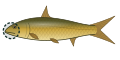 Largemouth Yellowfish - A long head with a big mouth right at the tip of the snout that opens forwards.
-
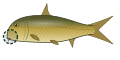 Smallmouth Yellowfish - A short, rounded snout with a small mouth underneath that opens downwards.
-
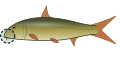 Clanwilliam Yellowfish - A small mouth under the snout with thick lips, and it lives only in the Olifants-Doring rivers of the Western Cape.
What it eats
Young fish eat insect larvae, freshwater shrimps and plankton. From about 1.5 kg they become hunters that eat mostly small fish, plus crabs and shrimps, often hunting in groups of 4–10.
Where it feeds
- Deep, slow river pools deeper than 2 m
- Rock ledges, cliffs and overhanging trees
- Rocky structure and drop-offs in big dams
How to catch it
Fly fishing with streamers is the classic method: a 7–9 weight rod, a floating or intermediate line and a long leader, because these fish are line-shy. Fish baitfish and crab patterns slowly through deep pools and along rock ledges. Small crankbaits, spinners and soft plastics on spinning tackle also catch them. Use a strong tippet and plenty of backing, as big fish run far.
| Way of fishing | How well it works |
|---|---|
| Bait on the bottomA sinker holds your bait still on the bottom. | Sometimes |
| Under a bobberA bobber is a small buoy on your line: it holds the bait off the bottom and dips under when a fish bites. | Not used |
| Pap, mielies, boilies and floatsSweet baits on the hook (pap, mielies, boilies or floats), with more thrown in around them. | Sometimes |
| Natural or dead baitReal food on the hook: worms, liver, sardine, chokka. | Sometimes |
| Live baitA small live fish or other live creature on the hook. | Not used |
| LuresArtificial baits you cast and reel in: spinners, spoons, plastics. | Works well |
| Fly fishingLight artificial flies, cast with a fly rod. | Best |
Baits and lures that work
- Streamers and baitfish flies
- Crankbaits and plugs
- Soft plastics
- Spinners
- Topwater lures and poppers
- Freshwater crabs
Flavours it likes
It hunts by sight, so flavour does not matter. What counts is a natural-looking fly or lure in black, olive, brown or white that moves like a small fish or crab.
When it bites
Time of day
| Time | Bite |
|---|---|
| Dawn | Best |
| Day | Good |
| Midday | Slow |
| Dusk | Best |
| Night | Rarely |
In summer fish early and late, when it hunts in low light. In winter the best bite is around midday on a warm, sunny day. It hardly feeds after dark.
Best months
- Best: March, April, May, September, October
- Good: February, June, July, August, November
Late winter and spring before the rains, when rivers are low and clear, and autumn from March to May are the best times. Avoid the summer floods and the spawning season from November to January.
What affects the bite
| Condition | What it likes | Effect on the bite |
|---|---|---|
| Water temperature | Best at 16–24 °C | High |
| Time of day | Best at dawn and dusk | Medium |
| Air pressure | Best when it is falling | Medium |
| Cloud cover | Best on overcast days | Medium |
| Wind | Best with a light breeze | Medium |
| Rain | Best in dry weather | High |
| Water clarity | Best in clear water | High |
| Moon phase | Hardly matters | Low |
| Spawning | Feeds hard before and after spawning | High |
High means it makes a big difference to whether this fish bites. Low means it hardly matters.
Tips
- Look at the fish from below: if you cannot see its eyes, it is a largemouth.
- Use a long leader and a natural-coloured fly; these fish turn away from thick line.
- Keep the fish in the water while you unhook it, and let it recover before you let it go.
Good to know: Check the current rules: largemouth yellowfish are a protected, slow-growing species, and anglers release every one. Keep it in the water while you unhook it.
Are they biting today?
BaitLine's fishing forecast scores today's conditions for Largemouth Yellowfish hour by hour - free for everyone. Sign up free and get the whole Fishing guide in the app.