
Garrick
Lichia amia
A hard-fighting game fish of the surf and estuary mouths, caught mostly on live mullet and shad and on surface lures.
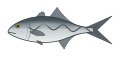
Size: Legal fish are mostly 70–110 cm, about 3–10 kg. The SA angling record is 32.2 kg.
Where: From the Orange River mouth around the coast to about Cape Vidal; young fish grow up in Cape and Eastern Cape estuaries, and adults seldom go more than 500 m from shore.
How to spot it
A silver, deep-bodied fish with a pointed snout, a dark grey-green back and a deeply forked, dark tail. The easiest clue is the lateral line, which runs in a clear wavy line along the side. The skin feels like smooth leather, which is where the name leervis comes from.
Varieties and look-alikes
-
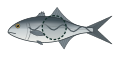 Garrick - The lateral line runs in a clear wavy line along the side, with no dark blotches.
-
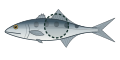 Queenfish - A straight lateral line with a row of dark blotches along the upper side.
What it eats
Garrick hunt fish: mullet (harders), shad, sardine, maasbanker and mackerel. They chase bait near the surface and ambush it where moving water hides them, such as rip currents and estuary mouths.
Where it feeds
- Estuary mouths on the incoming tide
- Rip currents and gullies just behind the breakers
- Around sardine and mullet shoals during the sardine run
- The lower reaches of larger estuaries and harbours
How to catch it
Swim a live mullet or shad on a single 4/0–6/0 circle hook through the top lip, on a leader of 1–1.5 m. When a garrick takes, open the bail arm or free the spool and count to about ten before you wind tight. Surface lures such as poppers and stickbaits, cast across a river mouth at first light, also work well.
| Way of fishing | How well it works |
|---|---|
| Bait on the bottomA sinker holds your bait still on the bottom. | Sometimes |
| Under a bobberA bobber is a small buoy on your line: it holds the bait off the bottom and dips under when a fish bites. | Sometimes |
| Natural or dead baitReal food on the hook: worms, liver, sardine, chokka. | Sometimes |
| Live baitA small live fish or other live creature on the hook. | Best |
| LuresArtificial baits you cast and reel in: spinners, spoons, plastics. | Works well |
| TrollingLures or bait pulled behind a moving boat. | Works well |
| Fly fishingLight artificial flies, cast with a fly rod. | Sometimes |
Baits and lures that work
- Live mullet (harders)
- Live baitfish
- Topwater lures and poppers
- Crankbaits and plugs
- Spoons
- Streamers and baitfish flies
Flavours it likes
Garrick hunt by sight and are drawn by movement, not smell. A lively bait, or a lure that splashes and wobbles, matters far more than any scent.
When it bites
Time of day
| Time | Bite |
|---|---|
| Dawn | Best |
| Day | Slow |
| Midday | Slow |
| Dusk | Best |
| Night | Slow |
Dawn and dusk are the best times, especially the first hour of light. Live baits also take fish at night, and during the day when bait is close in.
Best months
- Best: January, February, March, July, August, September, December
- Good: April, May, June, October, November
In the Cape and Eastern Cape, garrick are in the estuaries and surf from late October to April. Adults run up to KZN with the sardines in winter and spawn there from September to November, so July to September is garrick time in KZN.
What affects the bite
| Condition | What it likes | Effect on the bite |
|---|---|---|
| Water temperature | Best at 17–23 °C | Medium |
| Time of day | Best at dawn and dusk | Medium |
| Tide | Best on the incoming tide | Medium |
| Swell and surf | Best with some swell | Medium |
| Air pressure | Best when it is falling | Medium |
| Cloud cover | Best on overcast days | Medium |
| Wind | Best with a light breeze | High |
| Rain | Best in dry weather | High |
| Water clarity | Best in clear water | Medium |
| Moon phase | Hardly matters | Low |
| Spawning | Feeds hard before and after spawning | High |
High means it makes a big difference to whether this fish bites. Low means it hardly matters.
Tips
- If a garrick hits but does not hook up, give it slack and leave the bait in for a few minutes: it often comes back.
- Use smaller baits if you get many hits and no hook-ups.
- Release big garrick quickly: support them in the water and keep your hands away from the gills.
Good to know: The garrick stock has collapsed, so release what you do not need. Garrick are a recreational species and may not be sold. Check the current rules: 2 per person per day, at least 70 cm.
Are they biting today?
BaitLine's fishing forecast scores today's conditions for Garrick hour by hour - free for everyone. Sign up free and get the whole Fishing guide in the app.