Kob
Argyrosomus japonicus
South Africa's big surf and estuary fish that hunts at night and in dirty water, caught on live mullet, sardine, chokka and paddle tails.
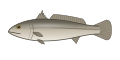
Size: Most surf and estuary kob are 60–110 cm, roughly 2–14 kg. They can reach 2 m and about 80 kg: the biggest on record in SA came from the surf at the Gamtoos River mouth in 2011.
Where: Dusky kob live from Cape Point to southern Mozambique, most of them from Cape Agulhas to northern KZN. Young kob grow up in muddy estuaries, and adults move between the surf, estuaries and reefs down to about 50 m.
How to spot it
A long, solid fish with a big mouth, a bronze to silver body and a coppery sheen on the head. Live fish often show a row of pale spots along the lateral line. The tail is rounded or slightly pointed in the middle, never forked. Three kinds live in SA: the dusky kob of the surf and estuaries, the silver kob, caught mostly from boats, and the squaretail kob of KZN.
Varieties and look-alikes
-
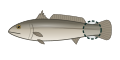 Dusky kob - The deepest, thickest tail stalk of the three, a short pectoral fin and a bronze sheen; it is the kob of the surf and estuaries.
-
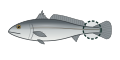 Silver kob - A longer, slimmer tail stalk, a longer pectoral fin and a cleaner silver colour, without the dusky kob's strong brassy smell.
-
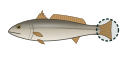 Squaretail kob - The tail ends almost straight across instead of rounded, and the fins are orange-brown.
-
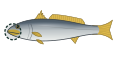 Geelbek - Yellow inside the mouth and along the jaws, and a tail that curves inward.
What it eats
Adults eat mostly fish, such as mullet, sardine and small kob, plus chokka, cuttlefish and prawns. Kob hunt by feel and smell as much as by sight, so they feed well in dark or dirty water.
Where it feeds
- Deep holes, channels and bends in estuaries, especially muddy ones
- Gullies and channels just behind the first breakers
- River mouths, and the line where brown and clean water meet
- Harbours, reefs and wrecks down to about 50 m (from a boat)
How to catch it
From the shore, fish a single circle hook (8/0–12/0) on about a metre of soft leader, with a live mullet or a whole sardine, in a gully just behind the first break. In estuaries, go lighter: a live mullet of 8–10 cm, prawn, or a small paddle tail worked slowly along the bottom. Kob seldom chase fast lures, so fish low and slow.
| Way of fishing | How well it works |
|---|---|
| Bait on the bottomA sinker holds your bait still on the bottom. | Best |
| Under a bobberA bobber is a small buoy on your line: it holds the bait off the bottom and dips under when a fish bites. | Not used |
| Natural or dead baitReal food on the hook: worms, liver, sardine, chokka. | Best |
| Live baitA small live fish or other live creature on the hook. | Best |
| LuresArtificial baits you cast and reel in: spinners, spoons, plastics. | Works well |
| TrollingLures or bait pulled behind a moving boat. | Sometimes |
| Fly fishingLight artificial flies, cast with a fly rod. | Sometimes |
Baits and lures that work
- Live mullet (harders)
- Sardine
- Chokka (squid)
- Soft plastics
- Fish strips or dead fish
- Mackerel
- Spoons
Flavours it likes
- Fish
- Squid
Kob find food by smell and feel in dirty water, so fresh, oily bait works best: a fresh sardine, a fillet of shad or mackerel, or chokka. Change your bait often so the scent stays strong.
When it bites
Time of day
| Time | Bite |
|---|---|
| Dawn | Best |
| Day | Slow |
| Midday | Slow |
| Dusk | Best |
| Night | Best |
Fish an hour or two either side of sunrise and sunset, and on into the night. In clean water, most bites come after dark.
Best months
- Best: January, February, March, October, November, December
- Good: April, May, June, July, August, September
In the Cape, kob come on from about October and fish well through summer. In KZN and the Transkei, big kob gather on reefs to spawn in late winter and spring, and kob are caught from the shore during the winter sardine run.
What affects the bite
| Condition | What it likes | Effect on the bite |
|---|---|---|
| Water temperature | Best at 16–24 °C | Low |
| Time of day | Best at dawn, dusk and night | High |
| Tide | Best on the incoming tide | Medium |
| Swell and surf | Best with some swell | Medium |
| Air pressure | Best when it is falling | High |
| Cloud cover | Best on overcast days | Medium |
| Wind | Best with a light breeze | Medium |
| Rain | Best after rain | High |
| Water clarity | Best in murky water | High |
| Moon phase | Best around new and full moon | Low |
| Spawning | Feeds hard before and after spawning | Medium |
High means it makes a big difference to whether this fish bites. Low means it hardly matters.
Tips
- After rain, fish where a river mouth pushes brown water into the sea.
- The last two hours of the incoming tide and the first hour of high tide are the best.
- Use circle hooks and just wind tight when the line runs: the hook sets in the corner of the mouth, which is kinder to fish you release.
Good to know: Dusky kob stocks have collapsed and the fish grow slowly, so release big breeding fish. Check the current rules: from the shore and in estuaries east of Cape Agulhas, 1 kob per person per day, at least 60 cm; west of Cape Agulhas, 5 per day, at least 50 cm; and never more than one kob over 110 cm a day.
Are they biting today?
BaitLine's fishing forecast scores today's conditions for Kob hour by hour - free for everyone. Sign up free and get the whole Fishing guide in the app.