
Spotted Grunter
Pomadasys commersonnii
The top estuary fish of the Eastern Cape and KZN, caught on prawn on the pushing tide and stalked on fly on the flats.
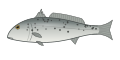
Size: Most legal fish are 40–60 cm, about 0.7–2 kg, and a grunter over 4 kg is a real trophy. The SA angling record is 9.5 kg, caught in Durban in 1949.
Where: From the Breede River in the Western Cape up the whole east coast to Kosi Bay and beyond. Most are caught in estuaries, harbours and bays, from the Kowie and Great Fish to Durban Bay, Richards Bay and St Lucia.
How to spot it
A silvery-grey fish with a pointed snout and a small mouth set low, made for digging prawns out of the sand. The back, upper sides and dorsal fin are covered in small dark spots, and there is a dark spot on the edge of the gill cover. It grunts by grinding its teeth when you land it.
Varieties and look-alikes
-
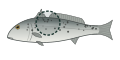 Spotted Grunter - Many small dark spots scattered over the back, upper sides and dorsal fin.
-
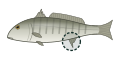 Javelin grunter - No scattered spots: young fish have faint dark bars, adults are plainer and golden-green, and the anal fin has one long, strong spine.
What it eats
Grunter blow jets of water into sand and mud to flush out sand prawn, mud prawn and pencil bait, and also eat small crabs, worms and shrimps. On shallow flats they feed head-down with their tails waving above the water, which anglers call tailing.
Where it feeds
- Sand and mud banks with lots of prawn holes
- Shallow flats on the pushing tide, often in less than knee-deep water
- Channel edges and drop-offs next to the flats
- Harbours and bays with a sandy bottom
How to catch it
Use light tackle: a small running sinker above a swivel, then about 50 cm of leader and a size 2–1/0 hook threaded with a sand or mud prawn. Cast onto the edge of a bank and keep the line just slack enough for a grunter to pick up the bait. Grunter often mouth a bait gently, so wait for the line to move off steadily before you lift the rod.
| Way of fishing | How well it works |
|---|---|
| Bait on the bottomA sinker holds your bait still on the bottom. | Best |
| Under a bobberA bobber is a small buoy on your line: it holds the bait off the bottom and dips under when a fish bites. | Not used |
| Natural or dead baitReal food on the hook: worms, liver, sardine, chokka. | Best |
| Live baitA small live fish or other live creature on the hook. | Not used |
| LuresArtificial baits you cast and reel in: spinners, spoons, plastics. | Sometimes |
| TrollingLures or bait pulled behind a moving boat. | Not used |
| Fly fishingLight artificial flies, cast with a fly rod. | Works well |
Baits and lures that work
- Sand prawn
- Mud prawn
- Bloodworm
- Pencil bait
- Prawns
- Crabs
Flavours it likes
- Crustacean
- Mussel
Grunter find their food by smell, so fresh or live prawn works far better than old, washed-out bait. Keep sand and mud prawn cool and damp.
When it bites
Time of day
| Time | Bite |
|---|---|
| Dawn | Good |
| Day | Slow |
| Midday | Slow |
| Dusk | Best |
| Night | Good |
The tide matters more than the clock. The first couple of hours of the incoming tide are best, and an evening or night push is better still.
Best months
- Best: January, February, September, October, November, December
- Good: March, April, May, August
The best catches come from spring through summer, about September to February. In winter the estuaries cool down, and grunter avoid water colder than about 16 °C.
What affects the bite
| Condition | What it likes | Effect on the bite |
|---|---|---|
| Water temperature | Best at 18–27 °C | Medium |
| Time of day | Best at dawn, dusk and night | Medium |
| Tide | Best on the incoming tide | High |
| Swell and surf | Hardly matters | Low |
| Air pressure | Best when steady | Medium |
| Cloud cover | Hardly matters | Low |
| Wind | Best when it is calm | High |
| Rain | Best in dry weather | High |
| Water clarity | Hardly matters | Low |
| Moon phase | Best around new and full moon | Medium |
| Spawning | Feeds hard before and after spawning | Medium |
High means it makes a big difference to whether this fish bites. Low means it hardly matters.
Tips
- Walk the flats at low tide to find prawn holes, then fish there when the water comes back.
- In clear, shallow water, stand still and keep low: tailing grunter spook easily.
- Floods and heavy rain push grunter out of an estuary, so give it a few days after a big flood.
Good to know: Grunter are a recreational species and may not be sold. Check the current rules: 5 per person per day, at least 40 cm.
Are they biting today?
BaitLine's fishing forecast scores today's conditions for Spotted Grunter hour by hour - free for everyone. Sign up free and get the whole Fishing guide in the app.