
Nembwe
Serranochromis robustus
A big-mouthed, predatory bream of the upper Zambezi and Okavango, caught mainly on lures and prized by visiting anglers.
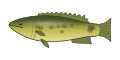
Size: A 2 kg nembwe is an excellent fish; they grow to about 3.5 kg, and a few bigger ones are reported.
Where: Native to the upper Zambezi above Victoria Falls, the Okavango, Kafue and Cunene. It has been stocked into Lake Kariba and other waters in Zimbabwe.
How to spot it
A long, solid bream with a big mouth, shaped more like a bass than a kurper. The sides are olive to yellow-green, and breeding fish have a bright yellow-orange throat and belly, which gives it the name yellow-belly. Okavango fish have orange edges on the dorsal and tail fins, upper Zambezi fish creamy-yellow ones.
Varieties and look-alikes
-
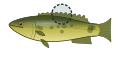 Nembwe - One long dorsal fin with no dip in the middle, and no dark stripe along the side.
-
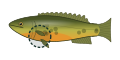 Breeding colours (yellow-belly) - Bright yellow-orange throat and belly in the breeding season.
-
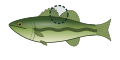 Largemouth Bass - A deep dip splits the dorsal fin in two, and a dark stripe runs along the side.
What it eats
An ambush hunter that eats small fish, plus insects, shrimps and small crabs. Big adults often feed on small squeaker catfish.
Where it feeds
- Deep main channels and permanent lagoons
- Overhanging banks, reed and papyrus edges, and small inlets
- Woody snags, weed beds and eroded clay banks
How to catch it
Spin or troll lures along shoreline structure and deep channels: small diving crankbaits, spinners, spoons, spinnerbaits and jigs all work. Use a light to medium spinning rod with 4–8 kg line, and expect a hard first strike near cover. Fly anglers use weighted baitfish flies on a 6–9 weight rod, cast tight into the reeds. Live bait and worms also catch them.
| Way of fishing | How well it works |
|---|---|
| Bait on the bottomA sinker holds your bait still on the bottom. | Not used |
| Under a bobberA bobber is a small buoy on your line: it holds the bait off the bottom and dips under when a fish bites. | Sometimes |
| Pap, mielies, boilies and floatsSweet baits on the hook (pap, mielies, boilies or floats), with more thrown in around them. | Not used |
| Natural or dead baitReal food on the hook: worms, liver, sardine, chokka. | Sometimes |
| Live baitA small live fish or other live creature on the hook. | Works well |
| LuresArtificial baits you cast and reel in: spinners, spoons, plastics. | Best |
| Fly fishingLight artificial flies, cast with a fly rod. | Works well |
Baits and lures that work
- Crankbaits and plugs
- Spinners
- Spoons
- Spinnerbaits
- Jigs
- Topwater lures and poppers
- Streamers and baitfish flies
- Small live fish
Flavours it likes
Nembwe hunt by sight, so movement, flash and a lure that looks like a small fish matter, not flavour. Slow down near cover and let the lure wobble past their hiding spot.
When it bites
Time of day
| Time | Bite |
|---|---|
| Dawn | Best |
| Day | Good |
| Midday | Slow |
| Dusk | Best |
| Night | Rarely |
Best in the early morning just after sunrise and in the last hour before sunset. Topwater lures work best in this low light; in bright midday sun, fish deeper.
Best months
- Best: May, June, July, August, September, October
- Good: March, April, November, December
Most active in the cooler dry-season months, from late May to October. In the summer rains the water turns murky, they spawn, and catches drop.
What affects the bite
| Condition | What it likes | Effect on the bite |
|---|---|---|
| Water temperature | Best at 18–27 °C | High |
| Time of day | Best at dawn and dusk | High |
| Air pressure | Best when steady or falling | Medium |
| Cloud cover | Best on overcast days | Medium |
| Wind | Best with a light breeze | Medium |
| Rain | Best in dry weather | Medium |
| Water clarity | Best in clear water | Medium |
| Moon phase | Hardly matters | Low |
| Spawning | Feeds hard before and after spawning | Medium |
High means it makes a big difference to whether this fish bites. Low means it hardly matters.
Tips
- Cast tight to the bank and into gaps in the reeds; nembwe ambush from cover.
- When you fish for tigerfish near the bank, expect nembwe on the same lures.
- Use a short wire trace in rivers with tigerfish, which bite through line.
Good to know: Fish from a boat on these rivers; hippos and crocodiles make the banks dangerous. Catch and release is the norm at most lodges.
Are they biting today?
BaitLine's fishing forecast scores today's conditions for Nembwe hour by hour - free for everyone. Sign up free and get the whole Fishing guide in the app.