
Threespot Tilapia
Oreochromis andersonii
A big kurper (bream) of the Zambezi and Okavango with three black spots on its side, prized for its hard fight and good eating.
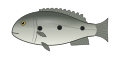
Size: A 2 kg fish is a good one in the Okavango; upper Zambezi fish pass 3 kg, and the biggest top 4 kg.
Where: Native to the upper Zambezi, Kafue, Okavango and Cunene rivers, and found in Lake Kariba and Cahora Bassa. It does not occur naturally in South Africa.
How to spot it
A deep-bodied, silvery-grey kurper with three or four round black spots in a row along the middle of the side. The dorsal and tail fins have red edges, and the tail has no stripes. Breeding males turn dark purplish-brown, which hides the spots, with broad bright red fin edges and bigger jaws.
Varieties and look-alikes
-
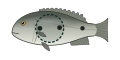 Threespot Tilapia - Three or four round black spots in a row along the side, and red edges on the dorsal and tail fins.
-
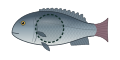 Blue Tilapia - Faint blotches at most and a longer snout; this is the kurper of South African waters.
-
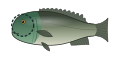 Greenhead Tilapia - No spots at all, a rounded forehead and a green sheen on the head.
What it eats
Mostly fine detritus, algae and tiny animals sifted from the bottom. Bigger fish eat more insects and other small creatures, and guides find they feed like predators for a few months of the year.
Where it feeds
- Deep bays and channels near sunken trees and other hidden structure
- Quiet, weedy backwaters and lily-pad lagoons
- Hippo pools and deep, slow water 3–6 m down
How to catch it
Fish a bunch of red earthworms on the bottom with a long-shank hook near structure; this is the most successful method on the upper Zambezi. Small spinners, size 3–4, retrieved slowly along the bottom also take them. In the Okavango, fly anglers catch them on small nymphs in the backwaters.
| Way of fishing | How well it works |
|---|---|
| Bait on the bottomA sinker holds your bait still on the bottom. | Best |
| Under a bobberA bobber is a small buoy on your line: it holds the bait off the bottom and dips under when a fish bites. | Works well |
| Pap, mielies, boilies and floatsSweet baits on the hook (pap, mielies, boilies or floats), with more thrown in around them. | Not used |
| Natural or dead baitReal food on the hook: worms, liver, sardine, chokka. | Best |
| Live baitA small live fish or other live creature on the hook. | Not used |
| LuresArtificial baits you cast and reel in: spinners, spoons, plastics. | Works well |
| Fly fishingLight artificial flies, cast with a fly rod. | Works well |
Baits and lures that work
- Earthworms
- Spinners
- Nymphs
- Spoons
Flavours it likes
Added flavours play no real part here: a fresh, lively red worm on the bottom is what works.
When it bites
Time of day
| Time | Bite |
|---|---|
| Dawn | Best |
| Day | Best |
| Midday | Good |
| Dusk | Best |
| Night | Rarely |
Feeds by day, best in the early morning and late afternoon. Midday in the hot months is slower, and night is poor.
Best months
- Best: June, July, August, September, October
- Good: March, April, May, November, December
Best in the dry season from June to October, when the rivers drop and clear. In the summer rains and floods the water turns murky and the fish spread onto the floodplains, so catches drop.
What affects the bite
| Condition | What it likes | Effect on the bite |
|---|---|---|
| Water temperature | Best at 21–30 °C | High |
| Time of day | Best at dawn and dusk | Medium |
| Air pressure | Best when steady or falling | Medium |
| Cloud cover | Hardly matters | Low |
| Wind | Best with a light breeze | Low |
| Rain | Best in dry weather | Medium |
| Water clarity | Best in clear water | Medium |
| Moon phase | Hardly matters | Low |
| Spawning | Eats less while it spawns | Medium |
High means it makes a big difference to whether this fish bites. Low means it hardly matters.
Tips
- Use a long-shank hook; it makes unhooking easier when a fish swallows the worm.
- Once you find a shoal, stay put: they can be caught in numbers when you match what they are eating.
- Fish from a boat on these rivers; hippos and crocodiles make the banks unsafe.
Good to know: Threespot are listed as Vulnerable, largely because of alien tilapias that compete and breed with them. Release big breeding fish.
Are they biting today?
BaitLine's fishing forecast scores today's conditions for Threespot Tilapia hour by hour - free for everyone. Sign up free and get the whole Fishing guide in the app.