
Redbreast Tilapia
Coptodon rendalli
A big, weed-loving kurper with a red chest, found in warm Lowveld and KwaZulu-Natal waters and the Zambezi. A strong fighter on light tackle.
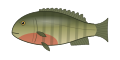
Size: Grows to about 45 cm and 2.5 kg, second in size only to blue kurper among our native kurper. On the upper Zambezi a 2 kg fish is a good one.
Where: Native to east-flowing rivers from the Limpopo south to the Tugela, so it is common in Limpopo, Mpumalanga and northern KwaZulu-Natal; it has been stocked further afield, including Gauteng and North West. Also found in the Zambezi and Okavango systems.
How to spot it
A deep-bodied kurper with a steep, rounded forehead and a small mouth. The body is olive to brownish with about six faint dark bars, and the chest and belly are red or pink, brightest in breeding fish. Young fish have a dark tilapia spot on the soft part of the dorsal fin.
Varieties and look-alikes
-
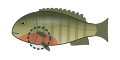 Redbreast Tilapia - Red or pink chest and belly, a rounded forehead and faint bars.
-
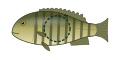 Banded Tilapia - Smaller and yellowish, with 8–9 bold dark bars and no red belly.
-
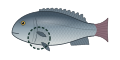 Blue Tilapia - Silvery grey with no red on the chest, and a straight forehead.
What it eats
Mainly a plant eater: water weed, algae and soft leaves. It also eats insects, worms, small crabs and small fish, which is why worms catch it.
Where it feeds
- Dense weed beds and lily pads in quiet water
- Slow, deep river pools and backwaters
- Weedy dam margins, where pairs clear nests up to a metre wide in summer
How to catch it
Fish a worm under a bobber on the edge of the weed, or on the bottom with a small running sinker. Use stronger line than for other kurper, because it dives into the weed when hooked. On the Zambezi, red earthworms on a long-shank hook and small spinners worked slowly along the bottom catch the most. On fly, a big fly with a small nymph trailing behind works well.
| Way of fishing | How well it works |
|---|---|
| Bait on the bottomA sinker holds your bait still on the bottom. | Works well |
| Under a bobberA bobber is a small buoy on your line: it holds the bait off the bottom and dips under when a fish bites. | Best |
| Pap, mielies, boilies and floatsSweet baits on the hook (pap, mielies, boilies or floats), with more thrown in around them. | Sometimes |
| Natural or dead baitReal food on the hook: worms, liver, sardine, chokka. | Best |
| Live baitA small live fish or other live creature on the hook. | Not used |
| LuresArtificial baits you cast and reel in: spinners, spoons, plastics. | Sometimes |
| Fly fishingLight artificial flies, cast with a fly rod. | Works well |
Baits and lures that work
- Earthworms
- Crickets, grasshoppers and other insects
- Bread
- Nymphs
- Spinners
Flavours it likes
As a plant and insect eater it is drawn by fresh, natural food rather than added flavours. Use lively worms and keep your bait fresh.
When it bites
Time of day
| Time | Bite |
|---|---|
| Dawn | Good |
| Day | Best |
| Midday | Good |
| Dusk | Good |
| Night | Rarely |
A daytime feeder in the weedy shallows, best through the morning and afternoon. It seldom bites at night.
Best months
- Best: January, February, March, October, November, December
- Good: April, May, September
In South Africa the best months are October to March, when pairs guard nests and strike hard. On the upper Zambezi, July to December is best, before the summer floods.
What affects the bite
| Condition | What it likes | Effect on the bite |
|---|---|---|
| Water temperature | Best at 23–31 °C | High |
| Time of day | Best during the day | Medium |
| Air pressure | Best when steady or falling | High |
| Cloud cover | Best on clear days | Low |
| Wind | Best with a light breeze | Low |
| Rain | Best in dry weather | Medium |
| Water clarity | Hardly matters | Low |
| Moon phase | Hardly matters | Low |
| Spawning | Strikes to guard its nest | Low |
High means it makes a big difference to whether this fish bites. Low means it hardly matters.
Tips
- Fish tight to the weed edge; a redbreast seldom swims far from cover.
- Lift it away from the weed quickly after the strike, before it buries itself.
- On the Zambezi, the same worm and spinner rig catches both redbreast and threespot.
Good to know: Pairs guard their eggs and fry together, unlike blue kurper that carry them in the mouth. It is good eating.
Are they biting today?
BaitLine's fishing forecast scores today's conditions for Redbreast Tilapia hour by hour - free for everyone. Sign up free and get the whole Fishing guide in the app.