
Trout
Oncorhynchus mykiss (rainbow), Salmo trutta (brown)
Rainbow and brown trout: cold-water fish stocked in highland dams and wild in mountain streams, and the backbone of SA fly fishing.
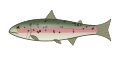
Size: A typical stillwater trout is under 2 kg, but stocked trophy dams hold fish over 8 kg. Wild river fish run smaller, though some pass 5 kg.
Where: Cool highland waters: Dullstroom and the Mpumalanga highlands, the KZN Midlands and Drakensberg, the North Eastern Cape Highlands around Rhodes and Barkly East, and Western Cape mountain streams such as the Smalblaar, Holsloot and Witte. Also Lesotho and Nyanga in Zimbabwe.
How to spot it
A streamlined fish with small scales and a small fleshy adipose fin on the back near the tail. Rainbow trout are silvery with a pink to red band along the side and small black spots all over, tail included. Brown trout are golden-brown with black and red spots ringed by pale halos, and few or no spots on the tail. Most trout in South Africa are rainbows.
Varieties and look-alikes
-
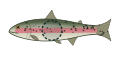 Rainbow trout - A pink band along the side and small black spots all over, tail included.
-
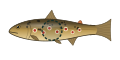 Brown trout - Golden-brown with red and black spots ringed by pale halos, and a plain, square tail.
What it eats
Mostly insects: mayfly, caddis and midge larvae and pupae, dragonfly and damselfly nymphs, and beetles, ants and hoppers blown onto the water. Bigger trout, browns most of all, also eat small fish, crabs and frogs.
Where it feeds
- Dams: shallow water under about 1 m, weed-bed edges, drop-offs, inlets and wind lanes
- Rivers: behind boulders, at the head and tail of pools, along seams and under undercut banks
- Big browns: deep pools with cover
- In summer heat: deep by day, in the shallows at first light
How to catch it
Fly fishing is the main method, and many waters allow nothing else: nymphs, buzzers and Woolly Buggers on dams, and nymphs or dry flies on streams, with a 4–6 weight rod for dams and a 2–4 weight for streams. Where spinning is allowed, small spinners and spoons retrieved steadily catch plenty of trout. Where bait is allowed, a worm drifted down a stream or fished under a bobber also works.
| Way of fishing | How well it works |
|---|---|
| Bait on the bottomA sinker holds your bait still on the bottom. | Sometimes |
| Under a bobberA bobber is a small buoy on your line: it holds the bait off the bottom and dips under when a fish bites. | Sometimes |
| Pap, mielies, boilies and floatsSweet baits on the hook (pap, mielies, boilies or floats), with more thrown in around them. | Not used |
| Natural or dead baitReal food on the hook: worms, liver, sardine, chokka. | Sometimes |
| Live baitA small live fish or other live creature on the hook. | Not used |
| LuresArtificial baits you cast and reel in: spinners, spoons, plastics. | Works well |
| Fly fishingLight artificial flies, cast with a fly rod. | Best |
Baits and lures that work
- Nymphs
- Streamers and baitfish flies
- Dry flies
- Spinners
- Spoons
- Earthworms
Flavours it likes
Trout feed by sight on insects and small fish, so flavour plays no part. Match the size and colour of what is hatching; in winter, bright orange or flashy flies stripped fast draw strikes from spawning fish.
When it bites
Time of day
| Time | Bite |
|---|---|
| Dawn | Best |
| Day | Good |
| Midday | Slow |
| Dusk | Best |
| Night | Rarely |
The first and last hours of light are best, especially in summer, when trout come into the shallows only at dawn and dusk. In winter the warmest part of the day can fish well, and on cool, overcast days they feed all day.
Best months
- Best: April, May, August, September
- Good: March, June, July, October, November
Autumn (April to May) and late winter to early spring (August to September) are the best months. Summer is hard on dams as the water warms, and rivers in the summer-rainfall areas often run dirty.
What affects the bite
| Condition | What it likes | Effect on the bite |
|---|---|---|
| Water temperature | Best at 8–17 °C | High |
| Time of day | Best at dawn and dusk | Medium |
| Air pressure | Best when it is falling | Medium |
| Cloud cover | Best on overcast days | High |
| Wind | Best with a light breeze | Medium |
| Rain | Best in light rain | Medium |
| Water clarity | Best in clear water | High |
| Moon phase | Hardly matters | Low |
| Spawning | Feeds hard before and after spawning | Medium |
High means it makes a big difference to whether this fish bites. Low means it hardly matters.
Tips
- On a dam, an overcast day with a light breeze usually beats a bright, flat calm one.
- On streams, cast upstream and let the fly drift naturally with the current.
- Fish the shallows early, then go deeper with a sinking line as the sun gets up.
Good to know: Check the current rules: you need a provincial licence for public waters, and many trout waters are private, fly-only or catch-and-release, with their own permits, seasons and bag limits. Trout are alien fish, so never move them to another water.
Are they biting today?
BaitLine's fishing forecast scores today's conditions for Trout hour by hour - free for everyone. Sign up free and get the whole Fishing guide in the app.