
Largemouth Bass
Micropterus salmoides
South Africa's main lure fish: an introduced American bass found in dams in every province, caught on soft plastics, crankbaits and topwater lures.
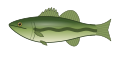
Size: Most fish are 0.5–2 kg, and a 3 kg fish is a good one. The SA record is 7.19 kg, caught at Loskop Dam in 2018.
Where: Brought in from the USA in 1928 and now in dams in all nine provinces, from farm dams to big public dams such as Loskop, Albert Falls, Midmar and Clanwilliam. It also lives in some slow rivers in the Eastern and Western Cape and in the Vaal above the Barrage.
How to spot it
A thick, green bass with a big head and a very wide mouth. With the mouth closed, the upper jaw reaches past the back of the eye. A dark, ragged band runs along the side from the gill cover to the tail, and the belly is white. A deep notch almost splits the spiny and soft parts of the dorsal fin in two.
Varieties and look-alikes
-
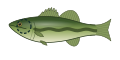 Largemouth Bass - The upper jaw reaches well past the back of the eye, and one dark band runs along the side with no spots below it.
-
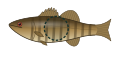 Smallmouth Bass - Bronze-brown with dark vertical bars and no band along the side, and the jaw stops below the eye.
-
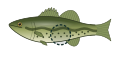 Spotted Bass - Rows of small dark spots on the pale lower sides, and the jaw stops at the back of the eye, not past it.
What it eats
Small fish, frogs and water insects, and it likes big prey. It hides in cover, waits for food to come past, then sucks it in with its wide mouth.
Where it feeds
- Weed beds, lily pads and reeds
- Drowned trees, branches and rocky reefs
- Points and drop-offs close to cover
- Shallow, sheltered bays in spring
How to catch it
Use a medium-power lure rod with fluorocarbon line, or braid with a fluorocarbon leader. Cast to cover and work the lure slowly past it: a soft plastic worm on a Texas rig, a crankbait or spinnerbait along banks and points, or a topwater lure in low light. Bass often take the lure as it sinks, so watch your line.
| Way of fishing | How well it works |
|---|---|
| Bait on the bottomA sinker holds your bait still on the bottom. | Not used |
| Under a bobberA bobber is a small buoy on your line: it holds the bait off the bottom and dips under when a fish bites. | Sometimes |
| Pap, mielies, boilies and floatsSweet baits on the hook (pap, mielies, boilies or floats), with more thrown in around them. | Not used |
| Natural or dead baitReal food on the hook: worms, liver, sardine, chokka. | Sometimes |
| Live baitA small live fish or other live creature on the hook. | Not used |
| LuresArtificial baits you cast and reel in: spinners, spoons, plastics. | Best |
| Fly fishingLight artificial flies, cast with a fly rod. | Works well |
Baits and lures that work
- Soft plastics
- Crankbaits and plugs
- Spinnerbaits
- Topwater lures and poppers
- Jigs
- Streamers and baitfish flies
- Earthworms
Flavours it likes
Bass hunt by sight and by feeling movement in the water, so the lure's action, size and colour count far more than scent. A scented soft plastic can make a bass hold on a moment longer.
When it bites
Time of day
| Time | Bite |
|---|---|
| Dawn | Best |
| Day | Good |
| Midday | Slow |
| Dusk | Best |
| Night | Slow |
Fish the first and last two hours of light, and keep going into dusk. In the bright middle of the day, fish deeper or slow down tight against shade and thick cover.
Best months
- Best: March, April, September, October
- Good: January, February, May, August, November, December
Spring (September–November) and autumn (March–May) are best, and big females feed hard in late winter before they spawn. Summer fishes best early and late; winter is slow but can give a big fish on a slow lure near the bottom.
What affects the bite
| Condition | What it likes | Effect on the bite |
|---|---|---|
| Water temperature | Best at 22–29 °C | High |
| Time of day | Best at dawn and dusk | High |
| Air pressure | Best when it is falling | High |
| Cloud cover | Best on overcast days | High |
| Wind | Best with a light breeze | Medium |
| Rain | Best in light rain | Medium |
| Water clarity | Best with a little colour in the water | Medium |
| Moon phase | Hardly matters | Low |
| Spawning | Strikes to guard its nest | High |
High means it makes a big difference to whether this fish bites. Low means it hardly matters.
Tips
- Before a cold front, as the pressure drops and cloud builds, bass often feed hard. The bright, still day after a front is usually slow.
- A windy bank is often the best bank: the wind pushes baitfish in. Fish a spinnerbait or crankbait there.
- In spring, males guard nests in shallow, sheltered water. Put a fish from a nest back quickly where you caught it, so it can return to the eggs.
Good to know: Check the current rules: bass are a listed alien species, so you may not move them to other waters, and in some rivers you must keep bass instead of releasing them. Public waters need a provincial angling licence.
Are they biting today?
BaitLine's fishing forecast scores today's conditions for Largemouth Bass hour by hour - free for everyone. Sign up free and get the whole Fishing guide in the app.