
Smallmouth Bass
Micropterus dolomieu
A bronze, barred bass of Western and Eastern Cape rivers and a few dams, popular with fly and light-lure anglers for its strong fight.
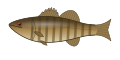
Size: Smaller than largemouth on average. In rich water it reaches about 40 cm and 1 kg after three years, and a fish bigger than that is a good one.
Where: Brought in from the USA in 1933. It lives mostly in the fynbos rivers of the Western and Eastern Cape, such as the Olifants-Doring, Breede, Berg and Gourits, and in dams such as Clanwilliam, Bulshoek and Brandvlei.
How to spot it
A brown to bronze bass with faint dark vertical bars on the sides and no dark band along the middle. Dark lines run back from the eye across the cheek, and the eye is often red. The upper jaw ends below the eye and never reaches past its back edge, and the two parts of the dorsal fin are joined with only a shallow notch.
Varieties and look-alikes
-
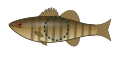 Smallmouth Bass - Bronze-brown with dark vertical bars and no band along the side, and the jaw stops below the eye.
-
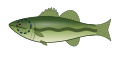 Largemouth Bass - The upper jaw reaches well past the back of the eye, and one dark band runs along the side with no spots below it.
-
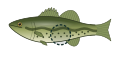 Spotted Bass - Rows of small dark spots on the pale lower sides, and the jaw stops at the back of the eye, not past it.
What it eats
Small fish, freshwater crabs, frogs and water insects. It hunts around rocks and in current, often in clear water where it can see its food.
Where it feeds
- Rocky reefs, ledges and boulder runs
- Current seams and eddies below rapids
- Palmiet channels and undercut banks in rivers
- On dams in summer, cooler water about 2–3 m deep or deeper
How to catch it
Fish light: a light spinning rod, thin line and small lures. Small soft plastics on a jig head, small crankbaits and spinners worked along rocks and current lines all work. On fly, use an intermediate line with a beadhead damselfly nymph or a small streamer, let it sink, then strip it back in short pulls.
| Way of fishing | How well it works |
|---|---|
| Bait on the bottomA sinker holds your bait still on the bottom. | Not used |
| Under a bobberA bobber is a small buoy on your line: it holds the bait off the bottom and dips under when a fish bites. | Not used |
| Pap, mielies, boilies and floatsSweet baits on the hook (pap, mielies, boilies or floats), with more thrown in around them. | Not used |
| Natural or dead baitReal food on the hook: worms, liver, sardine, chokka. | Sometimes |
| Live baitA small live fish or other live creature on the hook. | Not used |
| LuresArtificial baits you cast and reel in: spinners, spoons, plastics. | Best |
| Fly fishingLight artificial flies, cast with a fly rod. | Works well |
Baits and lures that work
- Soft plastics
- Crankbaits and plugs
- Spinners
- Jigs
- Streamers and baitfish flies
- Nymphs
- Topwater lures and poppers
- Freshwater crabs
Flavours it likes
Smallmouth hunt by sight in clear water, so the lure's size, colour and movement count, not flavour. Crab colours and natural baitfish colours work well.
When it bites
Time of day
| Time | Bite |
|---|---|
| Dawn | Best |
| Day | Good |
| Midday | Slow |
| Dusk | Best |
| Night | Rarely |
Early morning and late afternoon are best, but river fish in clear water also feed through the day. Night fishing seldom works.
Best months
- Best: March, April, September, November
- Good: January, February, May, June, August, October, December
Spring and autumn are best; in summer, fish early and late. Smallmouth like cooler water than largemouth, so winter days on dams can still fish well. They spawn from late August, about 2–3 weeks before largemouth, and bite less for a couple of weeks after the spawn in early October.
What affects the bite
| Condition | What it likes | Effect on the bite |
|---|---|---|
| Water temperature | Best at 17–26 °C | High |
| Time of day | Best at dawn and dusk | Medium |
| Air pressure | Best when it is falling | High |
| Cloud cover | Best on overcast days | Medium |
| Wind | Best with a light breeze | Medium |
| Rain | Best in dry weather | High |
| Water clarity | Best in clear water | Medium |
| Moon phase | Hardly matters | Low |
| Spawning | Strikes to guard its nest | High |
High means it makes a big difference to whether this fish bites. Low means it hardly matters.
Tips
- After heavy rain the rivers run muddy and the bite dies. Wait for the water to clear, or fish a dam.
- Look for current: the seam where fast water meets slow water, or the eddy behind a big rock, holds feeding fish.
- Wear polarised glasses to see rocks, ledges and cruising fish in clear river water.
Good to know: Check the current rules: smallmouth bass are a listed alien species that harms the Cape's indigenous fish, so you may not move them, and in some rivers you must keep bass instead of releasing them. Indigenous fish must be released.
Are they biting today?
BaitLine's fishing forecast scores today's conditions for Smallmouth Bass hour by hour - free for everyone. Sign up free and get the whole Fishing guide in the app.