
Spotted Bass
Micropterus punctulatus
A rare bass in South Africa, mainly in the Olifants-Doring system and Clanwilliam Dam, that looks like a largemouth with spotted lower sides.
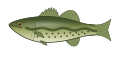
Size: Usually smaller than a largemouth. The biggest reach about 60 cm and 5 kg.
Where: Rare in South Africa. It is found mainly in the Olifants-Doring system in the Western Cape, including Clanwilliam Dam, and CapeNature has removed it from some side rivers to protect indigenous fish.
How to spot it
Very like a largemouth: green, with a dark band along the side, but the band is broken into blotches. Below it, the pale lower sides have rows of small dark spots that form thin lines. The upper jaw reaches the back of the eye but not past it, and you can feel a rough patch of tiny teeth on the tongue with a finger.
Varieties and look-alikes
-
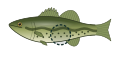 Spotted Bass - Rows of small dark spots on the pale lower sides, and the jaw stops at the back of the eye, not past it.
-
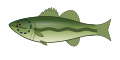 Largemouth Bass - The upper jaw reaches well past the back of the eye, and one dark band runs along the side with no spots below it.
-
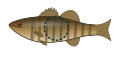 Smallmouth Bass - Bronze-brown with dark vertical bars and no band along the side, and the jaw stops below the eye.
What it eats
Small fish, insects and crabs. It often hunts in schools along deeper rocks and drop-offs.
Where it feeds
- Rocky points, ledges and drop-offs
- Deeper water than largemouth, especially after a cold front
- Open water near rocks, where it schools
- Shallow banks in spring, to spawn
How to catch it
Fish as you would for largemouth, but deeper and with smaller lures. A small soft plastic on a jig head or drop-shot rig, a small crankbait, or a jig hopped down rocky slopes all work. Where you catch one, cast again: they often swim in schools.
| Way of fishing | How well it works |
|---|---|
| Bait on the bottomA sinker holds your bait still on the bottom. | Not used |
| Under a bobberA bobber is a small buoy on your line: it holds the bait off the bottom and dips under when a fish bites. | Sometimes |
| Pap, mielies, boilies and floatsSweet baits on the hook (pap, mielies, boilies or floats), with more thrown in around them. | Not used |
| Natural or dead baitReal food on the hook: worms, liver, sardine, chokka. | Sometimes |
| Live baitA small live fish or other live creature on the hook. | Not used |
| LuresArtificial baits you cast and reel in: spinners, spoons, plastics. | Best |
| Fly fishingLight artificial flies, cast with a fly rod. | Works well |
Baits and lures that work
- Soft plastics
- Jigs
- Crankbaits and plugs
- Spinnerbaits
- Topwater lures and poppers
- Streamers and baitfish flies
- Earthworms
Flavours it likes
Spotted bass hunt by sight and movement, so the lure's action and size matter more than flavour. Natural colours that look like small fish work best in clear water.
When it bites
Time of day
| Time | Bite |
|---|---|
| Dawn | Best |
| Day | Good |
| Midday | Slow |
| Dusk | Best |
| Night | Slow |
Dawn and dusk are best, with steady fishing through the day in deeper water. Nights are slow.
Best months
- Best: March, April, September, October
- Good: January, February, May, June, August, November, December
Spring and autumn are best, and they spawn in about September–October. Spotted bass stay active in colder water than largemouth, so a winter day on a deep, rocky slope can still produce fish.
What affects the bite
| Condition | What it likes | Effect on the bite |
|---|---|---|
| Water temperature | Best at 18–28 °C | High |
| Time of day | Best at dawn and dusk | Medium |
| Air pressure | Best when it is falling | Medium |
| Cloud cover | Best on overcast days | Medium |
| Wind | Best with a light breeze | Medium |
| Rain | Best in light rain | Medium |
| Water clarity | Best in clear water | Medium |
| Moon phase | Hardly matters | Low |
| Spawning | Strikes to guard its nest | High |
High means it makes a big difference to whether this fish bites. Low means it hardly matters.
Tips
- To tell it from a largemouth, close the mouth: if the jaw stops at the back of the eye and the lower sides have rows of spots, it is a spotted bass.
- After a cold front, when largemouth go quiet, fish rocky slopes deeper for spotted bass.
- If you catch one, fish the same spot again: spotted bass often move in schools of fish the same size.
Good to know: Check the current rules: spotted bass are a listed alien species that harms indigenous fish, so never move them to other waters, and in rivers you may have to keep them instead of releasing them.
Are they biting today?
BaitLine's fishing forecast scores today's conditions for Spotted Bass hour by hour - free for everyone. Sign up free and get the whole Fishing guide in the app.