
Carp
Cyprinus carpio
South Africa's favourite freshwater fish: a strong bottom feeder caught on pap, mielies and boilies in almost every dam.
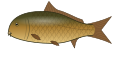
Size: Most carp caught in SA weigh 1–5 kg, but many dams hold fish over 20 kg. There is no official SA record; specimen anglers accept a 32.5 kg common carp as the biggest reported.
Where: Brought in from Europe long ago, carp now live in dams and slow rivers across South Africa, except cold mountain streams. The Vaal Dam, Gariep Dam and Bloemhof Dam are well-known carp waters.
How to spot it
A deep, heavy body with a humped back, a small head and a long dorsal fin that runs almost to the tail. It has rubbery lips and two pairs of barbels at the mouth. A common carp is bronze to olive with even scales. Mirror carp have a few big, shiny scales, leather carp almost none, and koi come in white, orange and black.
Varieties and look-alikes
-
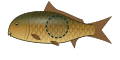 Common carp - Even rows of scales cover the whole body.
-
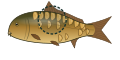 Mirror carp - Only a few big, shiny scales, mostly in a row along the back and scattered along the side and near the tail.
-
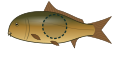 Leather carp - Smooth skin with no scales, or only a few along the back.
-
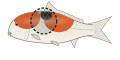 Koi - Bred in bright colours: white with orange, red or black patches.
What it eats
Carp root in the mud for bloodworms, insect larvae, snails, small mussels and worms, and also eat seeds and plant matter. They suck in food and blow out the mud, so bubbles and coloured water show where they feed.
Where it feeds
- Margins, reed lines and weed beds, especially at dawn and dusk
- The bank the wind blows onto, where food and warmer water collect
- Points, drop-offs and mussel beds in deeper water
- Deeper, cooler water on hot, bright days
How to catch it
Most SA anglers fish papgooi: squeeze pap around a stroppie's spring into a mieliebomb, push two hooks baited with mielies, floats or dough into it, and cast to the same spot every time so the feed builds up. For big carp, use boilies or tiger nuts on a hair rig with a heavy lead and a bite alarm, over a bed of mielies, hemp or tiger nuts. Always use a baitrunner reel: a carp can pull a rod into the dam.
| Way of fishing | How well it works |
|---|---|
| Bait on the bottomA sinker holds your bait still on the bottom. | Best |
| Under a bobberA bobber is a small buoy on your line: it holds the bait off the bottom and dips under when a fish bites. | Works well |
| Pap, mielies, boilies and floatsSweet baits on the hook (pap, mielies, boilies or floats), with more thrown in around them. | Best |
| Natural or dead baitReal food on the hook: worms, liver, sardine, chokka. | Works well |
| Live baitA small live fish or other live creature on the hook. | Not used |
| LuresArtificial baits you cast and reel in: spinners, spoons, plastics. | Not used |
| Fly fishingLight artificial flies, cast with a fly rod. | Sometimes |
Baits and lures that work
- Pap
- Sweetcorn
- Floats (floating hookbait)
- Boilies
- Tiger nuts
- Dough (sweet dough, egg dough)
- Bread
- Earthworms
Flavours it likes
- Strawberry
- Caramel
- Banana
- Garlic
- Eucalyptus/Bloekom
- Duiwelsdrek
Sweet flavours such as strawberry, caramel and banana work best in warm water. In cold water or a cold wind, switch to strong ones like garlic, bloekom or duiwelsdrek, and use more dip.
When it bites
Time of day
| Time | Bite |
|---|---|
| Dawn | Best |
| Day | Good |
| Midday | Slow |
| Dusk | Best |
| Night | Good |
Dawn and dusk are best, and carp keep feeding into the night. On hot, bright days the bite slows around midday.
Best months
- Best: January, February, March, April
- Good: May, August, September, October, November, December
January to April is best: the spawn is over and carp feed hard in warm water. From September to December they spawn in batches as the shallows warm, so the bite is patchy: good just before and between spawns, then quiet for days. In winter they feed less, but warm afternoons still produce fish.
What affects the bite
| Condition | What it likes | Effect on the bite |
|---|---|---|
| Water temperature | Best at 22–29 °C | High |
| Time of day | Best at dawn and dusk | Medium |
| Air pressure | Best when it is falling | Medium |
| Cloud cover | Best on overcast days | Medium |
| Wind | Best with the wind blowing towards your bank | High |
| Rain | Best in light rain | Low |
| Water clarity | Best with a little colour in the water | Low |
| Moon phase | Hardly matters | Low |
| Spawning | Stops eating while it spawns | High |
High means it makes a big difference to whether this fish bites. Low means it hardly matters.
Tips
- Cut the tip off each mielie so the flavour seeps out.
- Fish with the wind in your face: carp follow the wind to the bank it blows onto.
- Use an unhooking mat, keep the carp wet and put it back gently.
Good to know: Carp are a listed alien species. Check the current rules: you may put a carp back into the water you caught it in, but you may not move live carp to another dam or river.
Are they biting today?
BaitLine's fishing forecast scores today's conditions for Carp hour by hour - free for everyone. Sign up free and get the whole Fishing guide in the app.