
Mudfish
Labeo capensis
The Orange River mudfish: a hard-fighting, bottom-grazing labeo of the Orange-Vaal system, often caught on dough and nymphs.
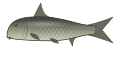
Size: It grows to about 50 cm. The SA angling record is 3.83 kg.
Where: Found in the Orange-Vaal system, from rivers like the Caledon and Kraai to big dams like the Gariep and Vaal. It has also been moved into the Great Fish River system in the Eastern Cape and the Crocodile River (West).
How to spot it
A streamlined, olive-grey to dark brown fish with a rounded snout, a mouth underneath with thick lips, and small barbels. In dams it can be silver or cream, often with orange flecks and a purple sheen, and it turns almost black when spawning. Its scales are bigger than a moggel's, and it has a large dorsal fin and a big forked tail.
Varieties and look-alikes
-
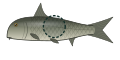 Mudfish - Bigger scales than a moggel and a large dorsal fin; lives mainly in the Orange-Vaal system.
-
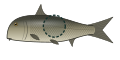 Moggel - Much smaller, finer scales than a mudfish and a shorter dorsal fin.
-
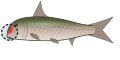 Rednose Labeo - Red bumps on the snout, a reddish top to the eye and a pinkish body; lives in lowveld rivers.
What it eats
It grazes algae and organic detritus off rocks and the bottom with its sucker-like mouth. It also takes small insect larvae, which is why nymphs catch it.
Where it feeds
- Rocky runs and rapids in rivers, behind rocks
- Shallow rocky stretches where it gathers to spawn after the first summer rains
- In dams, the bank the wind pushes the water onto
- Flowing water and structure, often alongside smallmouth yellowfish
How to catch it
On dams, fish papgooi-style, or put a soft bait such as sweet dough, egg dough, bread or an earthworm on a small hook and let a light sinker hold it on the bottom. In rivers, fly anglers do best with two nymphs, a heavy one above a small one, fished on a short line through the runs. A 6-weight fly rod with a floating line works well.
| Way of fishing | How well it works |
|---|---|
| Bait on the bottomA sinker holds your bait still on the bottom. | Works well |
| Under a bobberA bobber is a small buoy on your line: it holds the bait off the bottom and dips under when a fish bites. | Works well |
| Pap, mielies, boilies and floatsSweet baits on the hook (pap, mielies, boilies or floats), with more thrown in around them. | Best |
| Natural or dead baitReal food on the hook: worms, liver, sardine, chokka. | Works well |
| Live baitA small live fish or other live creature on the hook. | Not used |
| LuresArtificial baits you cast and reel in: spinners, spoons, plastics. | Not used |
| Fly fishingLight artificial flies, cast with a fly rod. | Works well |
Baits and lures that work
- Dough (sweet dough, egg dough)
- Bread
- Pap
- Earthworms
- Nymphs
- Dry flies
Flavours it likes
Anglers mostly use plain or sweet dough and fresh bread rather than strong dips.
When it bites
Time of day
| Time | Bite |
|---|---|
| Dawn | Best |
| Day | Good |
| Midday | Good |
| Dusk | Best |
| Night | Slow |
Mudfish feed mostly in daylight, best in the early morning and late afternoon. Few are caught at night.
Best months
- Best: January, February, March, October, November, December
- Good: April, May, August, September
October to March is best. After the first good summer rains they gather in shallow rocky rapids to spawn, which makes them easy to find in rivers.
What affects the bite
| Condition | What it likes | Effect on the bite |
|---|---|---|
| Water temperature | Best at 17–27 °C | High |
| Time of day | Best at dawn and dusk | Low |
| Air pressure | Best when it is falling | Medium |
| Cloud cover | Best on overcast days | Low |
| Wind | Best with the wind blowing towards your bank | High |
| Rain | Hardly matters | Low |
| Water clarity | Best with a little colour in the water | Low |
| Moon phase | Hardly matters | Low |
| Spawning | Feeds hard before and after spawning | Medium |
High means it makes a big difference to whether this fish bites. Low means it hardly matters.
Tips
- In rivers, fish the seams behind rocks in fast water.
- On a dam, fish the bank the wind is blowing onto.
- Fish a small nymph below a heavier one to get it down in fast water.
Good to know: Mudfish and moggel can interbreed in dams, so some fish show features of both. It is an indigenous fish: handle it gently and put it back.
Are they biting today?
BaitLine's fishing forecast scores today's conditions for Mudfish hour by hour - free for everyone. Sign up free and get the whole Fishing guide in the app.