
Grass Carp
Ctenopharyngodon idella
A big, plant-eating carp stocked to control weed, which cruises the shallows, spooks easily and runs hard when hooked.
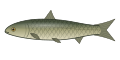
Size: Fish of 2–5 kg are common in SA dams, and big waters such as Bloemhof hold fish of 10–15 kg and more. They can grow over 1 m long and up to 50 kg.
Where: Not native: it was brought in during the 1960s and 1970s to control weed. It now lives in many large dams and rivers, most of all in Gauteng, KZN, Mpumalanga and the Free State, including the Vaal system.
How to spot it
A long, rounded, torpedo-shaped body with a broad head and no barbels. The eye sits low on the head and the mouth is at the front, not underneath. The short dorsal fin sits in the middle of the back. Large, dark-edged scales give an olive to silvery net pattern.
Varieties and look-alikes
-
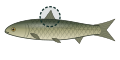 Grass Carp - A long, slim body with a short dorsal fin in the middle of the back and no barbels.
-
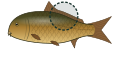 Carp - A deep body with a long dorsal fin that runs almost to the tail, and barbels at the mouth.
What it eats
Mainly soft water plants and grass, cut up with strong teeth in its throat. It also eats insects and other small animals living in the weed.
Where it feeds
- Shallow, weedy bays and margins close to the bank
- Flooded grass when the dam level rises
- Just under the surface on calm, sunny days
- Below dam walls and at inflows
How to catch it
Many grass carp are caught papgooi-style on a mieliebomb, with plain floats or mielies on the hook and a light hooklink. On calm, sunny days, throw out a few pieces of bread, then cast a piece on the hook with no sinker to fish feeding near the surface. Use a size 4 hook or bigger. Fly anglers catch them on nymphs cast close to fish moving in the shallows.
| Way of fishing | How well it works |
|---|---|
| Bait on the bottomA sinker holds your bait still on the bottom. | Works well |
| Under a bobberA bobber is a small buoy on your line: it holds the bait off the bottom and dips under when a fish bites. | Works well |
| Pap, mielies, boilies and floatsSweet baits on the hook (pap, mielies, boilies or floats), with more thrown in around them. | Best |
| Natural or dead baitReal food on the hook: worms, liver, sardine, chokka. | Works well |
| Live baitA small live fish or other live creature on the hook. | Not used |
| LuresArtificial baits you cast and reel in: spinners, spoons, plastics. | Not used |
| Fly fishingLight artificial flies, cast with a fly rod. | Works well |
Baits and lures that work
- Floats (floating hookbait)
- Sweetcorn
- Bread
- Pap
- Dough (sweet dough, egg dough)
- Boilies
- Nymphs
Flavours it likes
- Caramel
- Banana
- Bunspice
- Strawberry
Sweet flavours such as caramel, banana and bunspice are popular in SA. Plain, unflavoured floats and mielies also work well.
When it bites
Time of day
| Time | Bite |
|---|---|
| Dawn | Best |
| Day | Good |
| Midday | Good |
| Dusk | Best |
| Night | Rarely |
They feed in daylight, best in the early morning and late afternoon, and cruise near the surface on calm, sunny days. They rarely bite at night.
Best months
- Best: January, February, March, November, December
- Good: April, October
Fish for them in the warm months, October to April, when the water is above about 20 °C. They eat very little in cold water.
What affects the bite
| Condition | What it likes | Effect on the bite |
|---|---|---|
| Water temperature | Best at 20–31 °C | High |
| Time of day | Best at dawn and dusk | Medium |
| Air pressure | Best when steady or falling | Medium |
| Cloud cover | Best on clear days | Medium |
| Wind | Best when it is calm | High |
| Rain | Best in dry weather | Medium |
| Water clarity | Best in clear water | Medium |
| Moon phase | Hardly matters | Low |
| Spawning | Hardly changes | Low |
High means it makes a big difference to whether this fish bites. Low means it hardly matters.
Tips
- Look for swirls, moving weed or a back breaking the surface in the shallows.
- Keep low and quiet: in shallow water they spook easily.
- Set your drag properly before you cast: the first run is fast and strong.
Good to know: Grass carp are a listed invasive species. Check the current rules: only sterile (triploid) fish may be bred for stocking, live grass carp may not be moved to another water, and catch and release is allowed where they already occur.
Are they biting today?
BaitLine's fishing forecast scores today's conditions for Grass Carp hour by hour - free for everyone. Sign up free and get the whole Fishing guide in the app.