
Rednose Labeo
Labeo rosae
A silvery-pink labeo of warm lowveld rivers, named for the small red bumps on its snout, and an active, strong fish on light tackle.
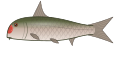
Size: It grows to about 40 cm and 3 kg, and is mature at about 15 cm.
Where: Common in the warm lowveld reaches of the Limpopo, Incomati and Phongolo systems, including the Olifants River and dams such as Loskop and Flag Boshielo.
How to spot it
A fairly deep, flattened body, golden green on the back with silvery-pink scales. The snout has small red bumps and the top of the eye is reddish. The mouth is underneath, with bumpy lips and one pair of short barbels, and the tall dorsal fin has a dished back edge. Young fish are silver with a black spot near the tail.
Varieties and look-alikes
-
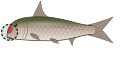 Rednose Labeo - Red bumps on the snout, a reddish top to the eye and a pinkish body; lives in lowveld rivers.
-
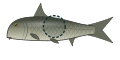 Mudfish - Bigger scales than a moggel and a large dorsal fin; lives mainly in the Orange-Vaal system.
-
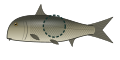 Moggel - Much smaller, finer scales than a mudfish and a shorter dorsal fin.
What it eats
It feeds on detritus, algae, small insects and other small animals, mostly over sand in the bigger rivers.
Where it feeds
- Sandy stretches of large, warm rivers
- Runs and riffles where food washes down
- Below weirs and rapids when it runs upstream in swollen summer rivers
How to catch it
Few anglers target it, so there is little local advice. Fish it like other river labeos: a small hook with an earthworm, dough or bread, either held on the bottom by a light sinker or hanging under a bobber in slow runs, or small nymphs on a light fly rod in the riffles.
| Way of fishing | How well it works |
|---|---|
| Bait on the bottomA sinker holds your bait still on the bottom. | Works well |
| Under a bobberA bobber is a small buoy on your line: it holds the bait off the bottom and dips under when a fish bites. | Works well |
| Pap, mielies, boilies and floatsSweet baits on the hook (pap, mielies, boilies or floats), with more thrown in around them. | Sometimes |
| Natural or dead baitReal food on the hook: worms, liver, sardine, chokka. | Works well |
| Live baitA small live fish or other live creature on the hook. | Not used |
| LuresArtificial baits you cast and reel in: spinners, spoons, plastics. | Not used |
| Fly fishingLight artificial flies, cast with a fly rod. | Works well |
Baits and lures that work
- Earthworms
- Dough (sweet dough, egg dough)
- Bread
- Nymphs
Flavours it likes
Use fresh, natural baits like earthworms and plain dough. No particular flavour is known to work better.
When it bites
Time of day
| Time | Bite |
|---|---|
| Dawn | Best |
| Day | Good |
| Midday | Good |
| Dusk | Best |
| Night | Slow |
Best in the early morning and late afternoon, with slower fishing at midday. Few are caught at night.
Best months
- Best: January, February, March, April, October, November, December
- Good: May, August, September
Spring to autumn is best, when the rivers are warm. In summer it runs upstream in swollen rivers to breed, leaping at weirs and other barriers.
What affects the bite
| Condition | What it likes | Effect on the bite |
|---|---|---|
| Water temperature | Best at 21–30 °C | High |
| Time of day | Best at dawn and dusk | Medium |
| Air pressure | Best when it is falling | Medium |
| Cloud cover | Best on overcast days | Low |
| Wind | Best with a light breeze | Medium |
| Rain | Hardly matters | Low |
| Water clarity | Best in clear water | Low |
| Moon phase | Hardly matters | Low |
| Spawning | Feeds hard before and after spawning | Medium |
High means it makes a big difference to whether this fish bites. Low means it hardly matters.
Tips
- Look for it in sandy runs of big lowveld rivers.
- Use light line and small hooks: it is an active, strong fish.
- Watch out for crocodiles and hippos when you fish lowveld rivers.
Good to know: It is a migratory fish, and weirs and nets have cut its numbers in some rivers. Put it back where you can.
Are they biting today?
BaitLine's fishing forecast scores today's conditions for Rednose Labeo hour by hour - free for everyone. Sign up free and get the whole Fishing guide in the app.