
Black Musselcracker
Cymatoceps nasutus
Poenskop, the black musselcracker: a powerful, slow-growing reef fish, caught from ski-boats on deep reefs and from rocks in the Eastern Cape.
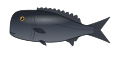
Size: Most fish caught today are under 5 kg, but they can reach 1.1 m and more than 30 kg. The SA angling record is 37.8 kg, caught in KZN in 1955.
Where: Endemic to South Africa, from Cape Agulhas to Cape Vidal. Young fish live on shallow reefs, many in the Transkei; big adults live on deeper reefs, especially off the Transkei and KZN.
How to spot it
A drab, dark grey to black fish with a heavy head, black soft fins and a white chin and belly. Big old fish grow a large fleshy bump on the snout, often called the nose. Young fish look very different: pale yellowish, with a dark head and two dark bars across the body. The scales above the lateral line are much smaller than those below.
Varieties and look-alikes
-
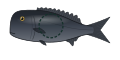 Black Musselcracker - Dark grey to black all over, with dark fins.
-
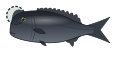 Poenskop, big old fish - Big old fish grow a large fleshy 'nose' on the snout.
-
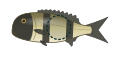 Young poenskop - Pale yellowish, with a dark head and two dark bars across the body.
-
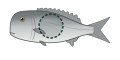 Musselcracker - Silver to silvery-blue, never black, with no bump on the snout.
What it eats
Eats snails, mussels, crabs, sea urchins and starfish, crushing the shells with heavy molar teeth. Young fish eat mostly crabs and other crustaceans.
Where it feeds
- Deep, high reefs and pinnacles, about 40–70 m deep off KZN
- Shallow reefs under 10 m (young fish)
- Rocky shores with deep water close in, in the Eastern Cape and Transkei
How to catch it
From a boat, fish a big bait on the bottom over high reef and pinnacles, with a 9/0–10/0 hook or a large circle hook on 0.8–1 mm line. A live mackerel, chokka with a fish fillet hanging below it, or a whole sardine all work. The bite is a series of hard jolts: wait for a solid pull before you strike, then pull hard to keep the fish off the reef. From the rocks, use heavy tackle and a big bait in deep water close in.
| Way of fishing | How well it works |
|---|---|
| Bait on the bottomA sinker holds your bait still on the bottom. | Best |
| Under a bobberA bobber is a small buoy on your line: it holds the bait off the bottom and dips under when a fish bites. | Not used |
| Natural or dead baitReal food on the hook: worms, liver, sardine, chokka. | Best |
| Live baitA small live fish or other live creature on the hook. | Works well |
| LuresArtificial baits you cast and reel in: spinners, spoons, plastics. | Not used |
| TrollingLures or bait pulled behind a moving boat. | Not used |
| Fly fishingLight artificial flies, cast with a fly rod. | Not used |
Baits and lures that work
- Chokka (squid)
- Live baitfish
- Fish strips or dead fish
- Sardine
- Crabs
- Octopus
- Redbait
Flavours it likes
- Squid
- Fish
- Crustacean
Big, fresh natural baits matter more than flavour. Chokka with a fish fillet, or a live mackerel, gives strong scent and movement on the reef.
When it bites
Time of day
| Time | Bite |
|---|---|
| Dawn | Best |
| Day | Good |
| Midday | Slow |
| Dusk | Best |
| Night | Slow |
They bite all day, but most fish come early in the morning and in the late afternoon and evening.
Best months
- Best: May, June, July, August, September, October
- Good: January, February, March, April, November, December
Found all year, but from May to October they gather to spawn over certain reefs in the Transkei and KZN, which is the best time.
What affects the bite
| Condition | What it likes | Effect on the bite |
|---|---|---|
| Water temperature | Best at 16–22 °C | Low |
| Time of day | Best at dawn and dusk | Medium |
| Tide | Hardly matters | Low |
| Swell and surf | Best with some swell | High |
| Air pressure | Best when steady or falling | Medium |
| Cloud cover | Hardly matters | Low |
| Wind | Best with a light breeze | High |
| Rain | Hardly matters | Low |
| Water clarity | Hardly matters | Low |
| Moon phase | Hardly matters | Low |
| Spawning | Feeds hard before and after spawning | Medium |
High means it makes a big difference to whether this fish bites. Low means it hardly matters.
Tips
- Add a big hook and bait to your normal reef rig, so you are ready when a poenskop comes past.
- Check your trace and swivels often: the reef and other fish's teeth wear the line.
- Release small or extra fish with a release weight that takes them back down to the bottom.
Good to know: Check the current rules: poenskop have a 50 cm minimum size and a bag limit of 1 per person per day. They take about 10 years to mature and can live over 45 years, so consider releasing big fish, and keep your fingers clear of the crushing teeth.
Are they biting today?
BaitLine's fishing forecast scores today's conditions for Black Musselcracker hour by hour - free for everyone. Sign up free and get the whole Fishing guide in the app.