
Steenbras
Lithognathus lithognathus
White steenbras, a prized, hard-fighting surf and estuary fish of the Cape coasts whose stocks have collapsed.
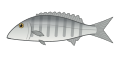
Size: Most fish caught are young fish under the 60 cm limit; they only mature at about 65 cm and 6 years old. They can grow to about 1.4 m, and the SA shore angling record is 26.3 kg.
Where: From the West Coast to the Transkei, most common along the Western and Eastern Cape coasts and rare in KZN. Young fish live in estuaries, from the Berg River to the Eastern Cape, for their first 2–3 years.
How to spot it
A long, silvery fish with a long, pointed 'pig' snout, very thick lips in adults and a mouth that pushes out to suck up prey. Young fish have 6–7 broad, dusky bars across the back, which fade in big fish. In shallow water you may see them head-down on the sandbanks, tails waving above the surface, as they blow prey out of the sand.
Varieties and look-alikes
-
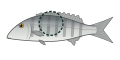 Steenbras - Long pig snout and 6–7 broad, faint bars that fade in big fish.
-
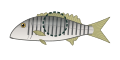 Sand steenbras - Smaller, usually 20–25 cm, with 14–17 narrow, sharp dark bars.
-
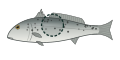 Spotted Grunter - Feeds on the same sandbanks, but has small dark spots and no bars.
What it eats
Digs in sand and mud for sand and mud prawns, worms, crabs and small clams such as white mussels, blowing water into the sand to expose them. Young fish in estuaries feed on the shallow banks, mostly at night.
Where it feeds
- Shallow sandbanks and gullies in the surf, often just behind the first breaker
- Drop-offs next to sandbanks
- Sandy lower reaches of estuaries
- Mixed sand and rock with black mussel
How to catch it
Use medium surf tackle with a running sinker trace and a long hook snood, so the fish can pick up the bait without feeling the sinker. A strong, short-shank 4/0–6/0 hook with a long, slender bait of bloodworm, prawn or white mussel tied on with cotton works well. When the line suddenly goes slack, don't strike: the fish has the bait and will run, so set the hook once it runs. Keep the drag loose until the hook is set, and take care in the shallows, where hooks often pull.
| Way of fishing | How well it works |
|---|---|
| Bait on the bottomA sinker holds your bait still on the bottom. | Best |
| Under a bobberA bobber is a small buoy on your line: it holds the bait off the bottom and dips under when a fish bites. | Not used |
| Natural or dead baitReal food on the hook: worms, liver, sardine, chokka. | Best |
| Live baitA small live fish or other live creature on the hook. | Not used |
| LuresArtificial baits you cast and reel in: spinners, spoons, plastics. | Not used |
| TrollingLures or bait pulled behind a moving boat. | Not used |
| Fly fishingLight artificial flies, cast with a fly rod. | Sometimes |
Baits and lures that work
- Bloodworm
- Sand prawn
- Mud prawn
- Prawns
- White mussel
- Crabs
- Octopus
- Sardine
Flavours it likes
- Crustacean
- Mussel
Fresh natural bait counts more than any flavour. Bloodworm and fresh prawn give off the scent of the animals steenbras dig out of the sand.
When it bites
Time of day
| Time | Bite |
|---|---|
| Dawn | Best |
| Day | Good |
| Midday | Slow |
| Dusk | Best |
| Night | Good |
Best at first light and dusk, and at night on a pushing tide. Bright, flat midday water is the slowest time.
Best months
- Best: January, February, March, October, November, December
- Good: April, May, June, July, August, September
Caught all year, but summer is the most popular season in the Western Cape. Many adults move east to spawn off the Transkei in July and August.
What affects the bite
| Condition | What it likes | Effect on the bite |
|---|---|---|
| Water temperature | Best at 15–21 °C | Low |
| Time of day | Best at dawn, dusk and night | Medium |
| Tide | Best on the incoming tide | Medium |
| Swell and surf | Best with some swell | High |
| Air pressure | Best when it is falling | Medium |
| Cloud cover | Best on overcast days | Medium |
| Wind | Best when it is calm | High |
| Rain | Hardly matters | Low |
| Water clarity | Best with a little colour in the water | Medium |
| Moon phase | Hardly matters | Low |
| Spawning | Hardly changes | Low |
High means it makes a big difference to whether this fish bites. Low means it hardly matters.
Tips
- Look for flat sandbanks with small, rolling white water, and fish close in.
- Use thin fluorocarbon for the hook snood: steenbras are shy feeders.
- Learn to tell them from sand steenbras and spotted grunter, so you know which rules apply.
Good to know: Check the current rules: white steenbras have a 60 cm minimum size and a bag limit of 1 per person per day, and may not be sold. The stock is badly overfished and most fish caught are undersized, so release small fish quickly, in the water.
Are they biting today?
BaitLine's fishing forecast scores today's conditions for Steenbras hour by hour - free for everyone. Sign up free and get the whole Fishing guide in the app.