Karanteen
Sarpa salpa
A small, gold-striped grazer of rocky gullies and harbours, caught on light tackle and used as live bait for garrick and kob.
Size: Usually 15–25 cm and a few hundred grams, and they reach about 30 cm here. The SA shore angling record is 0.7 kg.
Where: From Saldanha Bay right around the coast to Maputo. Young fish grow up in the Cape and Eastern Cape, and adults move up to KZN to spawn in winter.
How to spot it
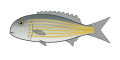
An oval, silver fish with about 8 bright golden-yellow stripes running from head to tail. The mouth is small, with cutting teeth for grazing seaweed. In the Cape it is called strepie, and in KZN karanteen.
What it eats
Adults graze mainly on red seaweed and now and then eat small shellfish. Very small young fish eat plankton.
Where it feeds
- Surf-zone gullies and shallow rocky reefs, usually shallower than 15 m
- Rock pools, harbours and calm bays with plenty of seaweed
- The white water in a gully as the tide pushes in
How to catch it
Use a light rod, thin line and very small hooks, because karanteen nibble. Bait with musselworm, a thin strip of redbait or a piece of mussel, and throw a little chopped bait into the gully to draw a shoal in. Wait until the tugs pull the rod tip down, then strike lightly. A small bobber helps you see the bites in a gully.
| Way of fishing | How well it works |
|---|---|
| Bait on the bottomA sinker holds your bait still on the bottom. | Works well |
| Under a bobberA bobber is a small buoy on your line: it holds the bait off the bottom and dips under when a fish bites. | Sometimes |
| Natural or dead baitReal food on the hook: worms, liver, sardine, chokka. | Best |
| Live baitA small live fish or other live creature on the hook. | Not used |
| LuresArtificial baits you cast and reel in: spinners, spoons, plastics. | Not used |
| TrollingLures or bait pulled behind a moving boat. | Not used |
| Fly fishingLight artificial flies, cast with a fly rod. | Not used |
Baits and lures that work
- Musselworm
- Redbait
- Mussel
- White mussel
- Sardine
Flavours it likes
- Mussel
- Fish
Karanteen follow a trail of fine bait in the water. A little sardine mince or chopped redbait thrown into the gully brings them up to your hook.
When it bites
Time of day
| Time | Bite |
|---|---|
| Dawn | Good |
| Day | Best |
| Midday | Best |
| Dusk | Good |
| Night | Rarely |
Karanteen feed in daylight, right through the middle of the day. They hardly bite at night.
Best months
- Best: April, May, June, July, August
- Good: January, February, March, September, October, November, December
In KZN the winter run from about April to September is the time, when shoals move up the coast to spawn over shallow reefs. In the Cape and Eastern Cape, young fish are found in summer in calm, weedy water.
What affects the bite
| Condition | What it likes | Effect on the bite |
|---|---|---|
| Water temperature | Best at 16–22 °C | Low |
| Time of day | Best during the day | Medium |
| Tide | Best on the incoming tide | Medium |
| Swell and surf | Best with some swell | Medium |
| Air pressure | Best when steady or falling | Medium |
| Cloud cover | Hardly matters | Low |
| Wind | Best with a light breeze | High |
| Rain | Best in dry weather | Medium |
| Water clarity | Hardly matters | Low |
| Moon phase | Hardly matters | Low |
| Spawning | Feeds hard before and after spawning | Medium |
High means it makes a big difference to whether this fish bites. Low means it hardly matters.
Tips
- Take the hard head off a musselworm; karanteen don't like it.
- Keep live karanteen cool in clean sea water and change it often. They die sooner than mullet.
- Play them gently on light line; they fight hard for their size.
Good to know: Check the current rules: karanteen have a minimum size of 15 cm and a daily bag limit of 10 per person, and fish you keep for bait count too.
Are they biting today?
BaitLine's fishing forecast scores today's conditions for Karanteen hour by hour - free for everyone. Sign up free and get the whole Fishing guide in the app.