
Blacktail
Diplodus capensis
The easy, plentiful rock fish of the south and east coasts, and a fun light-tackle fish for gullies and kids.
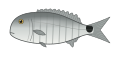
Size: Most fish caught are 20–30 cm and well under 1 kg. The SA angling record is 2.7 kg.
Where: Along the coast from Cape Point to southern Mozambique. A separate population lives in Namibia.
How to spot it
A deep, oval, silvery-grey fish with a fairly pointed snout and flat, chisel-like front teeth. The tell is a large black saddle on the tail root, just in front of the tail. The gill cover has a black edge, and young fish show faint dark bars that fade as they grow.
Varieties and look-alikes
-
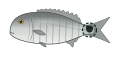 Blacktail - Silver-grey with one big black saddle on the tail root.
-
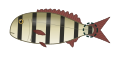 Zebra (wildeperd) - Five broad black bars on a yellowish body, with a full bar round the tail root instead of a saddle.
What it eats
An omnivore that eats red and green seaweed, sea urchins, worms and small shellfish. Young fish pick tiny crustaceans and worms off the rocks in pools and gullies.
Where it feeds
- Rock gullies and the wash around rocky points
- Sandy surf close to rocks
- Shallow reefs down to about 40 m
- Tidal pools and estuary mouths (young fish)
How to catch it
Use light tackle: a light rod, thin line, a small hook (size 1 to 1/0) and just enough sinker to hold in the gully. Bait with a small piece of prawn or redbait. You can also drift the bait under a bobber along the rocks, which is great fun for children. Keep the bait small and strike on the first firm pull.
| Way of fishing | How well it works |
|---|---|
| Bait on the bottomA sinker holds your bait still on the bottom. | Best |
| Under a bobberA bobber is a small buoy on your line: it holds the bait off the bottom and dips under when a fish bites. | Works well |
| Natural or dead baitReal food on the hook: worms, liver, sardine, chokka. | Best |
| Live baitA small live fish or other live creature on the hook. | Not used |
| LuresArtificial baits you cast and reel in: spinners, spoons, plastics. | Sometimes |
| TrollingLures or bait pulled behind a moving boat. | Not used |
| Fly fishingLight artificial flies, cast with a fly rod. | Sometimes |
Baits and lures that work
- Prawns
- Redbait
- Sand prawn
- Mussel
- Bloodworm
- Sardine
Flavours it likes
- Crustacean
- Mussel
Fresh bait catches more than any flavour. A small, fresh piece of prawn or redbait is hard for a blacktail to ignore.
When it bites
Time of day
| Time | Bite |
|---|---|
| Dawn | Best |
| Day | Good |
| Midday | Good |
| Dusk | Best |
| Night | Slow |
Blacktail feed in daylight, best in the early morning and late afternoon. They bite slowly at night.
Best months
- Best: January, February, March, April, September, October, November, December
- Good: May, June, July, August
Blacktail stay on the same reefs all year, so you can catch them in any month. When a big sea makes the open water sandy, fish the cleaner, sheltered gullies.
What affects the bite
| Condition | What it likes | Effect on the bite |
|---|---|---|
| Water temperature | Best at 16–22 °C | Low |
| Time of day | Best at dawn and dusk | Medium |
| Tide | Best on the incoming tide | Medium |
| Swell and surf | Best with some swell | Medium |
| Air pressure | Best when it is falling | High |
| Cloud cover | Best on overcast days | Low |
| Wind | Best with a light breeze | Medium |
| Rain | Hardly matters | Low |
| Water clarity | Best in clear water | Medium |
| Moon phase | Hardly matters | Low |
| Spawning | Hardly changes | Low |
High means it makes a big difference to whether this fish bites. Low means it hardly matters.
Tips
- In a rough, sandy sea, scale down and fish the gullies, where the water is cleaner.
- Keep baits small: big baits just get picked clean.
- Move along the rocks if there are no bites: blacktail stay in one small area, so a quiet spot seldom improves.
Good to know: Check the current rules: blacktail have a 20 cm minimum size and a bag limit of 5 per person per day, and may not be sold.
Are they biting today?
BaitLine's fishing forecast scores today's conditions for Blacktail hour by hour - free for everyone. Sign up free and get the whole Fishing guide in the app.