Galjoen
Dichistius capensis
South Africa's national fish: a tough, dark rock-and-surf fish caught in the white water on redbait and mussel, mostly in winter.
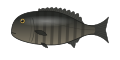
Size: Most legal fish are 35–45 cm. Males seldom pass 47 cm and 1.7 kg, but females grow bigger. The SA angling record is a 6.5 kg fish caught at Hermanus in 1930.
Where: From Namibia to about Durban, but most common on the West Coast, the Cape south coast and the Eastern Cape, where the water is cooler than about 21 °C. Rare on the KZN south coast.
How to spot it
A deep, oval, flat-sided fish with a small mouth, thick lips and strong, curved front teeth. Its colour changes with where it lives: almost black near rocks and silver-bronze over sand. The dorsal fin has strong spines at the front, and the scales sit very firmly.
Varieties and look-alikes
-
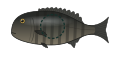 Galjoen - Deep, oval body with a small mouth; near rocks it is almost black all over.
-
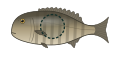 Galjoen over sand - The same fish turns silver-bronze over sandy bottoms, so don't go by colour alone.
-
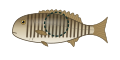 Banded galjoen - Smaller, with 17–19 narrow dark bars on a light body; mostly in KZN and the Transkei.
What it eats
Mainly brown mussels, redbait, barnacles and red seaweed scraped off the rocks, and white mussels on sandy beaches near rocks. It feeds in the broken white water, where waves knock food loose.
Where it feeds
- White water over mixed rock and sand
- Gullies and ledges with mussel and redbait beds
- Sandy beaches next to rocky points
- Shallow water close in, often just behind the first breaker
How to catch it
Fish a short, strong trace with one small, strong hook and a sinker, and cast into the white water close to the rocks. Pack the hook with redbait or mussel and wrap it on with bait elastic. Strike on the first firm pull and keep the fish out of the rocks. Medium surf tackle is enough, but use line that can take the rocks.
| Way of fishing | How well it works |
|---|---|
| Bait on the bottomA sinker holds your bait still on the bottom. | Best |
| Under a bobberA bobber is a small buoy on your line: it holds the bait off the bottom and dips under when a fish bites. | Sometimes |
| Natural or dead baitReal food on the hook: worms, liver, sardine, chokka. | Best |
| Live baitA small live fish or other live creature on the hook. | Not used |
| LuresArtificial baits you cast and reel in: spinners, spoons, plastics. | Not used |
| TrollingLures or bait pulled behind a moving boat. | Not used |
| Fly fishingLight artificial flies, cast with a fly rod. | Not used |
Baits and lures that work
- Redbait
- Mussel
- White mussel
- Bloodworm
- Sand prawn
Flavours it likes
- Mussel
- Crustacean
Fresh natural shellfish bait works better than any added flavour. Redbait has a strong smell that carries well in churning white water.
When it bites
Time of day
| Time | Bite |
|---|---|
| Dawn | Best |
| Day | Good |
| Midday | Good |
| Dusk | Best |
| Night | Slow |
Galjoen feed in daylight, best in the early morning and late afternoon. Night fishing is seldom worth it.
Best months
- Best: May, June, July, August
- Good: March, April, September
Winter is galjoen time, when cold fronts bring big seas and white water. Check the current rules: the season is closed from 15 October to the end of February.
What affects the bite
| Condition | What it likes | Effect on the bite |
|---|---|---|
| Water temperature | Best at 12–18 °C | Medium |
| Time of day | Best at dawn and dusk | Medium |
| Tide | Best on the incoming tide | Medium |
| Swell and surf | Best in rough, white water | High |
| Air pressure | Best when it is falling | High |
| Cloud cover | Best on overcast days | Medium |
| Wind | Best with the wind blowing towards your bank | High |
| Rain | Hardly matters | Low |
| Water clarity | Best with a little colour in the water | Low |
| Moon phase | Hardly matters | Low |
| Spawning | Eats less while it spawns | Medium |
High means it makes a big difference to whether this fish bites. Low means it hardly matters.
Tips
- Go when the sea is rough with plenty of white water; flat, clear seas fish poorly.
- Collect redbait and mussel at low tide during spring tides, where it is allowed and with the right permit.
- Wear gloves to handle redbait: the smell stays on your hands for days.
Good to know: Check the current rules: galjoen have a closed season from 15 October to the end of February, a 35 cm minimum size and a bag limit of 2 per person per day, and may not be sold.
Are they biting today?
BaitLine's fishing forecast scores today's conditions for Galjoen hour by hour - free for everyone. Sign up free and get the whole Fishing guide in the app.