
Cape Stumpnose
Rhabdosargus holubi
A small, silvery estuary and inshore bream with a yellow side band, caught on light tackle and prawn baits.
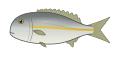
Size: Most fish are 15–25 cm, and adults seldom pass 1 kg. The SA shore angling record is 2.4 kg.
Where: From St Helena Bay to southern Mozambique, most common between Mossel Bay and East London. Young fish grow up in estuaries, especially in eelgrass beds, for their first one to two years.
How to spot it
A deep, flat-sided, bright silver fish with a blunt, fairly steep head. The tell is a bright yellow band along each side, from behind the head to the tail. The fins are yellowish or greenish, and there is a black spot where the pectoral fin meets the body.
Varieties and look-alikes
-
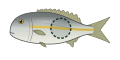 Cape Stumpnose - Bright silver with a yellow band along each side, from the head to the tail.
-
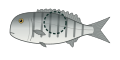 White stumpnose - No yellow band; instead 6–7 narrow dark bars across the back.
-
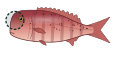 Red Stumpnose - Red all over, with a very steep head; a deep-reef fish caught from boats.
What it eats
Adults eat small shellfish, crabs, shrimps, worms, sea urchins and barnacles, crushing shells with their molar teeth. Young fish graze on eelgrass for the tiny animals and algae growing on it.
Where it feeds
- Eelgrass beds and sandbanks in estuaries
- Channels and drop-offs near estuary mouths
- Shallow sand between rocks along the coast
- Shallow reefs and sandy surf, less than 50 m deep
How to catch it
Use light tackle with thin line, a small hook and a light running sinker, or drift the bait under a bobber over the weed beds. Small pieces of sand prawn, mud prawn or worm work best. Many small fish nibble at the bait, so check it often and strike on a firm pull.
| Way of fishing | How well it works |
|---|---|
| Bait on the bottomA sinker holds your bait still on the bottom. | Best |
| Under a bobberA bobber is a small buoy on your line: it holds the bait off the bottom and dips under when a fish bites. | Works well |
| Natural or dead baitReal food on the hook: worms, liver, sardine, chokka. | Best |
| Live baitA small live fish or other live creature on the hook. | Not used |
| LuresArtificial baits you cast and reel in: spinners, spoons, plastics. | Sometimes |
| TrollingLures or bait pulled behind a moving boat. | Not used |
| Fly fishingLight artificial flies, cast with a fly rod. | Sometimes |
Baits and lures that work
- Sand prawn
- Mud prawn
- Prawns
- White mussel
- Bloodworm
- Redbait
Flavours it likes
- Crustacean
- Mussel
Fresh prawn and worm baits beat added flavours. Keep baits small to fit their small mouths.
When it bites
Time of day
| Time | Bite |
|---|---|
| Dawn | Best |
| Day | Good |
| Midday | Good |
| Dusk | Good |
| Night | Rarely |
A daytime fish. The early morning is best, the bite stays steady through the day, and it is poor at night.
Best months
- Best: January, February, March, April, October, November, December
- Good: May, June, July, August, September
Caught all year in estuaries. After heavy rain and floods the water turns brown, and the fishing drops off until it clears.
What affects the bite
| Condition | What it likes | Effect on the bite |
|---|---|---|
| Water temperature | Best at 17–24 °C | Medium |
| Time of day | Best during the day | Medium |
| Tide | Best on the incoming tide | Medium |
| Swell and surf | Best when the sea is calm | Low |
| Air pressure | Best when it is falling | Medium |
| Cloud cover | Hardly matters | Low |
| Wind | Best when it is calm | Medium |
| Rain | Best in dry weather | Medium |
| Water clarity | Best in clear water | Medium |
| Moon phase | Hardly matters | Low |
| Spawning | Hardly changes | Low |
High means it makes a big difference to whether this fish bites. Low means it hardly matters.
Tips
- Fish the incoming tide, when clean sea water pushes into the estuary.
- Use small hooks and small baits: most fish are under 25 cm.
- Learn the yellow side band: white stumpnose look similar but have dark bars and different rules.
Good to know: Check the current rules: Cape stumpnose have a 20 cm minimum size and a bag limit of 5 per person per day, and may not be sold. Many estuary fish are undersized, so release them gently in the water.
Are they biting today?
BaitLine's fishing forecast scores today's conditions for Cape Stumpnose hour by hour - free for everyone. Sign up free and get the whole Fishing guide in the app.