
Tigerfish
Hydrocynus vittatus
A hard-fighting, sharp-toothed freshwater gamefish of the Zambezi, Kariba, Okavango and Jozini, found in South Africa only in the far north-east.
Size: Most fish caught are 1–3 kg, and the big ones are females: males seldom pass 50 cm. Jozini has produced fish over 8 kg, and the IGFA world record, from Lake Kariba in 2001, was about 16 kg.
Where: In South Africa only in the north-east: the lower Pongola, Usutu and Komati rivers, Jozini (Pongolapoort) Dam and rivers in the Kruger Park. Further north it lives in the Limpopo, Zambezi, Chobe and Okavango systems and in Lakes Kariba and Cahora Bassa.
How to spot it
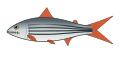
A silver, torpedo-shaped fish with black stripes along the sides, a deeply forked tail and red to orange fins. Big, sharp teeth stick out of both jaws, even with the mouth closed. A small fleshy fin (the adipose fin) sits between the dorsal fin and the tail.
What it eats
Mostly fish, chased down in open water, and it can take prey up to 40% of its own length. Packs gather where baitfish wash off floodplains or are driven by hunting catfish.
Where it feeds
- Current lines, eddies and channel mouths in rivers
- Drop-offs, points and rocky outcrops in dams and lakes
- Drowned trees and the edges of weed beds
- Wherever baitfish gather, in packs of fish the same size
How to catch it
Always use a wire trace: tigers bite through nylon. On dams, drift or anchor with a sardine or fish fillet and a little chum, or cast spoons, spinners and plugs over drop-offs and weed beds. Strike hard and keep the line tight, because the hook is hard to set in the bony mouth and many fish jump free.
| Way of fishing | How well it works |
|---|---|
| Bait on the bottomA sinker holds your bait still on the bottom. | Works well |
| Under a bobberA bobber is a small buoy on your line: it holds the bait off the bottom and dips under when a fish bites. | Sometimes |
| Pap, mielies, boilies and floatsSweet baits on the hook (pap, mielies, boilies or floats), with more thrown in around them. | Not used |
| Natural or dead baitReal food on the hook: worms, liver, sardine, chokka. | Best |
| Live baitA small live fish or other live creature on the hook. | Best |
| LuresArtificial baits you cast and reel in: spinners, spoons, plastics. | Best |
| Fly fishingLight artificial flies, cast with a fly rod. | Works well |
Baits and lures that work
- Sardine
- Small live fish
- Fish strips or dead fish
- Spoons
- Spinners
- Crankbaits and plugs
- Streamers and baitfish flies
Flavours it likes
- Fish
- Blood
Tigerfish find sardine and fish baits by the oil and blood in the water, so fresh, oily bait and a little chum draw them in. On lures, flash and a fast, darting action matter more than scent.
When it bites
Time of day
| Time | Bite |
|---|---|
| Dawn | Best |
| Day | Good |
| Midday | Slow |
| Dusk | Best |
| Night | Rarely |
The 2–3 hours after sunrise and before sunset are best. Tigers keep biting on hot, bright days, so fish deeper at midday rather than stopping; nights are poor on rod and line.
Best months
- Best: August, September, October, November
- Good: January, February, March, April, May, June, July, December
September to November is the peak, when tigers feed hard before spawning in the summer floods. March to May can also be good on Jozini, while rainy-season floods make river water dirty and winter cold slows the bite.
What affects the bite
| Condition | What it likes | Effect on the bite |
|---|---|---|
| Water temperature | Best at 21–31 °C | High |
| Time of day | Best at dawn and dusk | Medium |
| Air pressure | Best when steady or falling | Medium |
| Cloud cover | Best on clear days | Low |
| Wind | Best with a light breeze | Medium |
| Rain | Best in dry weather | Medium |
| Water clarity | Best in clear water | Medium |
| Moon phase | Best around new moon | Low |
| Spawning | Feeds hard before and after spawning | High |
High means it makes a big difference to whether this fish bites. Low means it hardly matters.
Tips
- Use single or circle hooks rather than trebles: they hold better in the bony mouth and do less harm to fish you release.
- When the sun is high, move from the shallow edges (4–5 m) to deeper spots with chum (8–10 m).
- Check your trace and knots after every fish: the teeth nick wire and line.
Good to know: The teeth cut, so unhook with pliers and keep your fingers clear, and watch for crocodiles and hippos when fishing from the bank. Check the current rules: tigerfish are protected in South Africa and are released on Jozini, and Botswana closes the Okavango to fishing in January and February.
Are they biting today?
BaitLine's fishing forecast scores today's conditions for Tigerfish hour by hour - free for everyone. Sign up free and get the whole Fishing guide in the app.