
Vundu Catfish
Heterobranchus longifilis
The Zambezi's giant catfish, the biggest true freshwater fish in southern Africa, fished at night with big meat baits on heavy tackle.
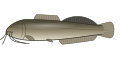
Size: It grows to about 1.5 m and 55 kg, and fish well over 1 m long are caught on Kariba and the Zambezi.
Where: Only in the Zambezi below Victoria Falls, including Lake Kariba, Chirundu, Kanyemba and the Lower Zambezi, and not in South African waters. It lives in deep river channels, deep pools, gorges and backwaters.
How to spot it
A huge catfish with a broad, flat head, tiny eyes and very long barbels that reach back towards the belly fins. Behind a long rayed dorsal fin sits a second, fleshy fin with no rays (the adipose fin), about as long as the first and darker at the back. The back is plain olive-brown, fading to light brown on the sides and an off-white belly. Each pectoral fin has a strong spine with saw teeth.
Varieties and look-alikes
-
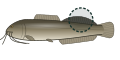 Vundu Catfish - A rayed dorsal fin, then a separate dark, fleshy fin with no rays, and very long barbels.
-
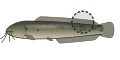 Barber - One long dorsal fin runs almost to the tail, with no fleshy fin behind it.
What it eats
Small vundu eat insects and other small water animals; big ones eat fish, frogs and small animals, and scavenge carcasses and offal. Its eyesight is poor, so it hunts by smell and by feeling vibrations, mostly at night.
Where it feeds
- Deep holes just out of the main current
- Along sandbars in the river, where it lies on the bottom
- River mouths and gorges on Kariba, such as the Sanyati
How to catch it
Fish a big piece of liver, ox heart, chicken or a fish fillet on the bottom with a running sinker, a long, strong single hook and a heavy nylon trace of about 35 kg. Many Kariba anglers chum the spot with blood, and some swear by blue bar soap as bait. Use heavy tackle and a firm drag, because a vundu either bulldozes along the bottom or runs hard for snags.
| Way of fishing | How well it works |
|---|---|
| Bait on the bottomA sinker holds your bait still on the bottom. | Best |
| Under a bobberA bobber is a small buoy on your line: it holds the bait off the bottom and dips under when a fish bites. | Not used |
| Pap, mielies, boilies and floatsSweet baits on the hook (pap, mielies, boilies or floats), with more thrown in around them. | Not used |
| Natural or dead baitReal food on the hook: worms, liver, sardine, chokka. | Best |
| Live baitA small live fish or other live creature on the hook. | Sometimes |
| LuresArtificial baits you cast and reel in: spinners, spoons, plastics. | Not used |
| Fly fishingLight artificial flies, cast with a fly rod. | Sometimes |
Baits and lures that work
- Red meat and offal
- Chicken liver
- Fish strips or dead fish
- Blue bar soap
Flavours it likes
- Blood
- Liver
- Fish
Vundu find food by smell, so blood, liver and old meat draw them best. Chumming a spot with blood can bring fish in within half an hour.
When it bites
Time of day
| Time | Bite |
|---|---|
| Dawn | Good |
| Day | Slow |
| Midday | Rarely |
| Dusk | Best |
| Night | Best |
Night is best, from dusk to dawn. In the day, fish deep holes or a spot you have chummed.
Best months
- Best: September, October, November
- Good: January, February, March, April, May, August, December
The warm months are best, and September to November, when the river is low, clear and warm, is the main season. In the rains (about December to March) the river floods and vundu spread onto the floodplains to breed.
What affects the bite
| Condition | What it likes | Effect on the bite |
|---|---|---|
| Water temperature | Best at 23–32 °C | High |
| Time of day | Best at night | High |
| Air pressure | Best when it is falling | Medium |
| Cloud cover | Best on overcast days | Low |
| Wind | Best with a light breeze | High |
| Rain | Best after rain | Medium |
| Water clarity | Hardly matters | Low |
| Moon phase | Hardly matters | Low |
| Spawning | Eats less while it spawns | Medium |
High means it makes a big difference to whether this fish bites. Low means it hardly matters.
Tips
- Keep baiting the same sandbar or hole: a vundu often shows itself with a loud splash, much louder than a barber's plop.
- Bring heavy tackle and spare hooks and sinkers, because vundu are hard on gear and big fish break light line in snags.
- Watch for crocodiles when you land or release a fish, and don't stand in the water.
Good to know: The serrated pectoral spines and rough jaws cause cuts and bruises, so handle a vundu with a wet cloth and support its weight. Most anglers on Kariba and the Zambezi photograph and release them; check the current local rules before you keep one.
Are they biting today?
BaitLine's fishing forecast scores today's conditions for Vundu Catfish hour by hour - free for everyone. Sign up free and get the whole Fishing guide in the app.