Tuna
Thunnus albacares, T. alalunga, T. obesus, Katsuwonus pelamis
The big offshore prize: yellowfin and longfin off Cape Point, yellowfin and skipjack off KZN, mostly caught by trolling far out at sea.
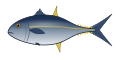
Size: Cape yellowfin average 35–60 kg, and fish over 100 kg are landed most seasons. Longfin are much smaller, and KZN catches range from tuna of 5–8 kg to yellowfin over 30 kg.
Where: Off the Cape, tuna are fished about 35–55 km out from Hout Bay, Simon's Town and Millers Point, in blue water off Cape Point. In KZN they are caught from the south coast to Sodwana, on bait marks and deep ledges, around ships and with dolphins.
How to spot it
Tuna are thick, bullet-shaped fish with a dark blue back, a silver belly, a crescent-shaped tail and a row of small finlets in front of it. The kinds SA anglers catch are told apart by their fins, eyes and stripes, as the drawings show.
Varieties and look-alikes
-
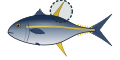 Yellowfin tuna - Long, bright yellow second dorsal and anal fins, yellow finlets and a gold stripe along the side.
-
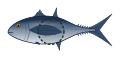 Longfin tuna (albacore) - A very long pectoral fin that reaches back past the second dorsal fin.
-
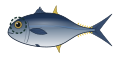 Bigeye tuna - A big eye and a deep, round body, with short yellowish fins.
-
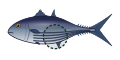 Skipjack tuna - Three to five dark stripes running along the silver belly.
What it eats
Tuna are fast open-water hunters that eat sardine, anchovy, mackerel, squid and other small fish and crustaceans. They gather at trawler slicks, floating objects, temperature breaks and bait shoals.
Where it feeds
- Temperature breaks and current lines in blue water, from about 18 °C
- Behind hake trawlers and longliners, in their slick of discarded fish
- On KZN bait marks and deep ledges, and around anchored ships
- With dolphins and under diving birds
How to catch it
Troll a spread of diving plugs and skirted lures at about 7–11 km/h until a fish strikes, then stop, chum with chopped sardine and drift a sardine down the slick on a fluorocarbon leader. In KZN, slow-trolled live mackerel, or poppers cast among dolphins and bait shoals, work well. Use strong gear: most Cape skippers fish 37 kg line on lever-drag reels.
| Way of fishing | How well it works |
|---|---|
| Bait on the bottomA sinker holds your bait still on the bottom. | Not used |
| Under a bobberA bobber is a small buoy on your line: it holds the bait off the bottom and dips under when a fish bites. | Sometimes |
| Natural or dead baitReal food on the hook: worms, liver, sardine, chokka. | Works well |
| Live baitA small live fish or other live creature on the hook. | Works well |
| LuresArtificial baits you cast and reel in: spinners, spoons, plastics. | Works well |
| TrollingLures or bait pulled behind a moving boat. | Best |
| Fly fishingLight artificial flies, cast with a fly rod. | Sometimes |
Baits and lures that work
- Skirted trolling lures
- Crankbaits and plugs
- Sardine
- Live baitfish
- Topwater lures and poppers
- Metal jigs
Flavours it likes
- Fish
Sardine is the key scent: a steady chum line of chopped sardine brings tuna up and keeps them near the boat.
When it bites
Time of day
| Time | Bite |
|---|---|
| Dawn | Best |
| Day | Good |
| Midday | Slow |
| Dusk | Good |
| Night | Rarely |
Launch before dawn. The first hours of light are best, especially for lures; when the bite slows later in the day, switch to live bait or a chum slick.
Best months
- Best: March, April, May, October, November, December
- Good: January, February, June, July, August, September
Off Cape Point the yellowfin come in two runs: March to June in calmer weather, and October to December with bigger fish and rougher weather. In KZN yellowfin can be caught most of the year, best from about October to June.
What affects the bite
| Condition | What it likes | Effect on the bite |
|---|---|---|
| Water temperature | Best at 18–24 °C | High |
| Time of day | Best at dawn and dusk | Medium |
| Tide | Hardly matters | Low |
| Swell and surf | Best when the sea is calm | High |
| Air pressure | Best when it is falling | Medium |
| Cloud cover | Best on clear days | Low |
| Wind | Best with a light breeze | High |
| Rain | Hardly matters | Low |
| Water clarity | Best in clear water | High |
| Moon phase | Hardly matters | Low |
| Spawning | Hardly changes | Low |
High means it makes a big difference to whether this fish bites. Low means it hardly matters.
Tips
- Watch the sea temperature: off Cape Point, start looking hard once it reaches about 18 °C.
- When one tuna hooks up, turn the boat broadside and chum: the rest of the shoal often stays.
- Go with an experienced skipper first. Far out at sea the south-easter can blow up to gale force with little warning.
Good to know: Check the current rules: the DFFE has listed a 3.2 kg minimum for yellowfin and bigeye tuna and a daily bag limit of 10 tuna per person.
Are they biting today?
BaitLine's fishing forecast scores today's conditions for Tuna hour by hour - free for everyone. Sign up free and get the whole Fishing guide in the app.